Welfare Digest | Poverty Fell Faster Before the War on Poverty
Links & Benefits Breakdowns


Here are this week’s links & benefit breakdowns:
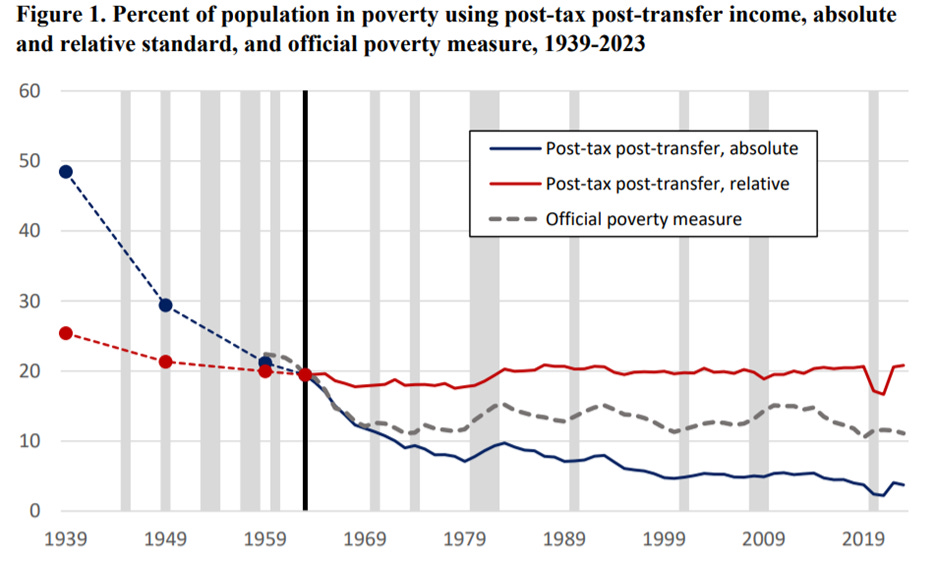
Poverty Fell Faster Before the War on Poverty. Building on their prior research that the Debt Dispatch covered, scholars Richard Burkhauser and Kevin Corinth, in their most recent NBER paper, measure poverty from 1939 to 2023 using a “full income” poverty measure that includes taxes and both cash and non-cash transfers. The paper finds, as Mercatus scholar Jack Salmon points out, that “the greatest era of poverty reduction came before the War on Poverty.” As Figure 1 shows, while poverty continued to decline after the War on Poverty began in 1964, the pace was no faster than before: 29 percentage points from 1939 to 1963 (48.5 percent to 19.5 percent), versus only 15.7 percentage points from 1963 to 2023 (19.5 percent to 3.7 percent). Furthermore, the pre-1964 decline in poverty among working-age adults and children was achieved almost completely through increases in market income, while the post-1964 decline was driven largely by government transfers. As Salmon observes, “the War on Poverty changed the how of poverty reduction (more transfers, more dependency), but it didn’t accelerate the how much.” For lasting poverty reduction, “policies that encourage capital formation, remove barriers to work, and widen opportunity will do more to reduce poverty in the long run than adding layers of permanent income replacement.”
The Broken Incentives Behind Minnesota’s Fraudulent Day Cares. As the Debt Dispatch has previously covered, “the lesson from Minnesota’s fraud scandal is that no amount of red tape can fix a system built on misaligned incentives.” For example, as NLRB Edge founder Matt Bruenig highlights, “the Minnesota day care schemes all occurred in programs where a private provider acts as a middleman between the government and individuals.” Under this model, the government provides funds to private entities that must use them to provide services; any unspent funds are kept as profit. “This outsourcing approach to welfare policy is inherently vulnerable to fraud” because “the best way to increase [profit] margins is to spend as little as possible on providing services” by “[degrading] the quality of services provided” or to “simply spend nothing on services by not providing them.” Economist Arnold Kling points out that, “if people were spending their own money, including money given to them by the government, they would not spend it on nonexistent day cares.”
Minimum Wage Hikes Hurt Low-Skill Minorities. As economists David Neumark and Jyotsana Kala point out, “advocates for higher minimum wages claim they are necessary to close the earnings gap between black and white workers.” But, as they show in their new NBER paper, minimum wage increases disproportionately harm the very people they're meant to help, particularly low-skilled black workers. Using American Community Survey data from 2005 to 2019, they found that for black workers under 30 without a high school degree, a 10 percent minimum wage increase reduced employment by an average of 4.1 percent and aggregate earnings by 4.8 percent. Minimum wage increases had a negligible impact on white workers with the same characteristics, and, in some cases, increased their earnings. Minimum wage increases also "fell disproportionately on people of all races living in areas with a high black population share," in some cases accounting for "roughly 40 percent of the gap in employment rates for lower-skilled workers between areas with high and low black population shares.” Rather than support higher minimum wages, policymakers “seeking to reduce racial disparities should… focus instead on other policies to improve economic opportunities for racial minorities.”
The SNAP Fraud Fix That States Won't Pay For. The federal government spent more than $106 billion on the Supplemental Nutrition Assistance Program (SNAP) in fiscal year 2025, according to the Congressional Budget Office (CBO)’s February 2026 baseline. As Cato scholar Chris Edwards points out, “one chronic failing of SNAP is that billions of dollars are lost through fraud and abuse.” SNAP is vulnerable to at least 10 types of fraud, including illegally selling benefits, reselling food, and collecting benefits in multiple states. One particularly prevalent form is EBT theft through card skimmers. Since 2023, “more than 670,000 households have had their food stamp benefits stolen by criminal rigging checkout terminals with fake card readers,” he writes. One way to prevent skimming is by placing chips on EBT cards. However, most states have yet to do so, likely because they’re “waiting for the feds to pay for the switch.” As both Edwards and the Debt Dispatch have noted, state administrators have little reason to minimize the fraud and abuse because the federal government funds SNAP benefits. But if states ran food stamp programs with their own money, they would have “strong incentives to minimize all types of waste.”
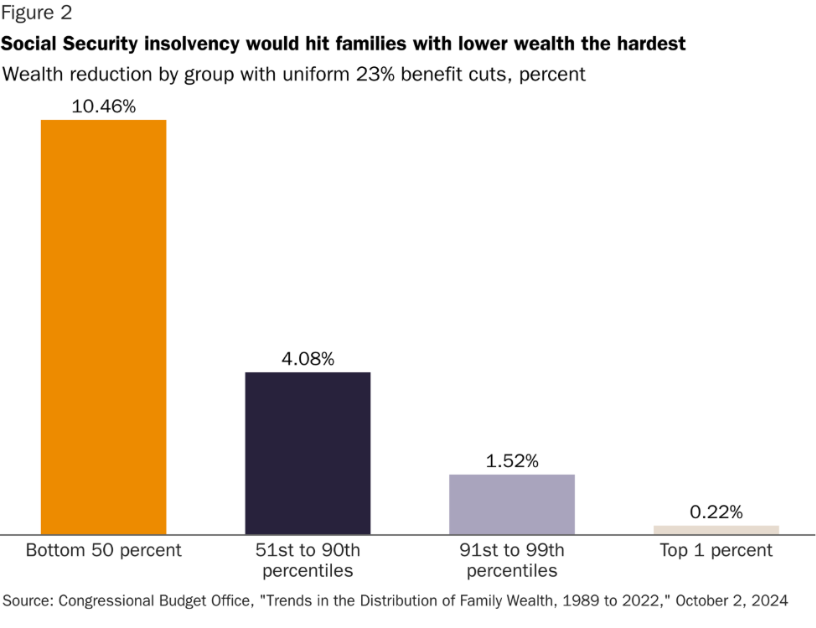
Social Security’s Upside Down Benefit Structure. Social Security faces insolvency by 2032, prompting contentious debate over how to reform the program. One reason for Social Security’s high costs, say AEI scholar Andrew Biggs and LIMRA Retirement Income Institute scholar Jason Fichtner, is that it is a “blunt tool for fighting poverty. Only 7 percent of retirement benefits go to the poorest 20 percent of older Americans, whereas the richest quintile receive 29 percent.” As Cato scholar Romina Boccia points out, this benefit structure creates an “upside-down safety net.” Without reform, “benefits will be cut across the board by roughly 23 percent within six years.” Consequently, “the retirees who rely most on Social Security will be hurt the most, while wealthy households will scarcely notice the change.” Instead of imposing higher payroll taxes or adding trillions to the debt by borrowing, a better way to reform Social Security is to “focus reforms where they do the least harm and the most good — by trimming earned benefits at the top to secure endangered benefits for those at the bottom.”