Welfare Digest | More Oversight Won't Fix Minnesota's Fraud Problem
Links & Benefits Breakdowns



Here are this week’s links & benefit breakdowns:
More Oversight Won't Fix Minnesota's Fraud Problem. The lesson from Minnesota’s fraud scandal is that no amount of red tape can fix a system built on misaligned incentives. Last month, a House Judiciary Committee hearing discussed the more than $9 billion in fraudulent spending across 14 of Minnesota’s state-administered, federally funded welfare programs over the past decade. Officials and experts including Dylan Hedtler-Gaudette of the Project on Government Oversight correctly noted that fraud on this scale stems from “deep, structural flaws, gaps, and weaknesses in our system of government,” not just isolated bad actors. But his “systemic solutions” were mostly just a litany of familiar fixes: more regulation, more supervision, more enforcement mechanisms, and, most likely, more money to pay for all of it. The structural flaw at the heart of this problem, as Cato scholar Chris Edwards has noted, is that all the programs implicated in Minnesota’s scandal share one defining trait: They’re administered by the state but funded almost entirely by the federal government. This financing structure gives state officials little incentive to run these programs efficiently or to prevent wasteful spending. It’s no surprise that Minnesota was so tepid in its response to financial mismanagement in the programs it was running—it’s someone else’s money, so it’s someone else’s problem. For example, Minnesota officials had flagged irregularities in the nonprofit Feeding Our Future’s funding for years but continued to approve payments. Perhaps the state would’ve been more decisive if the $250 million that went toward a phony children’s nutrition program had come out of its own coffers. This entire debacle exemplifies the vulnerabilities of federal aid-to-state programs. Fraudsters can exploit the system with scant resistance because those closest to the problem don’t bear the cost of mismanagement, while those who do are too far removed to act quickly.
Stronger federal oversight might catch fraud sooner, but the better solution is to realign incentives by ending federal funding for state-administered programs.
If Minnesota wants to run assistance programs, it should do so with Minnesota taxpayer dollars. True accountability in America’s welfare programs begins with states bearing the full consequences of running them poorly.
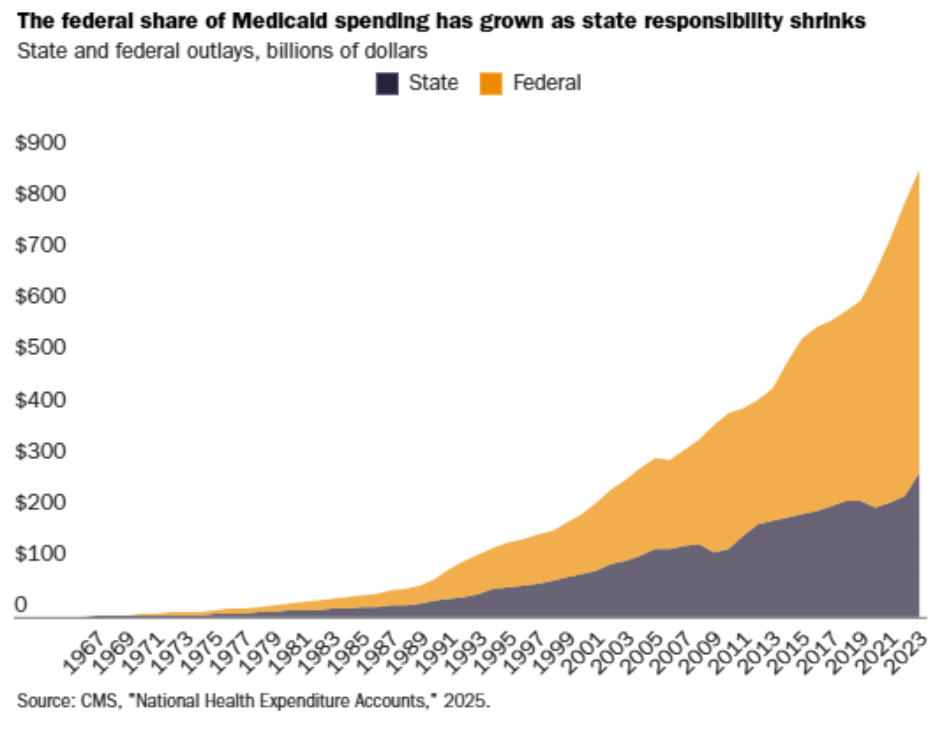
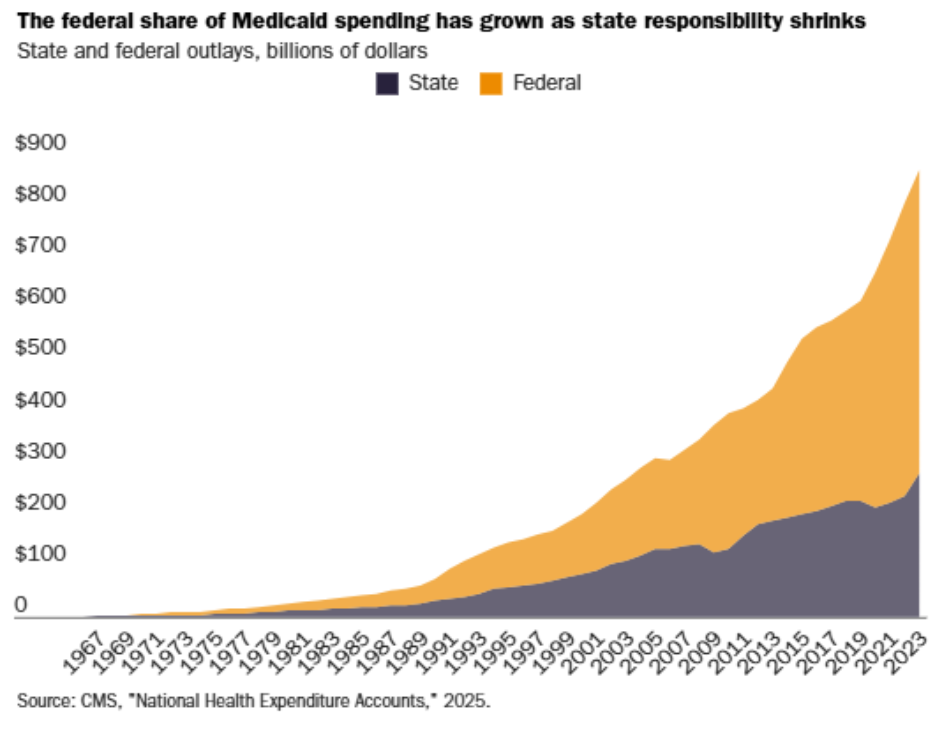
New York Fraud Exposes Structural Flaws in Medicaid. As Cato scholar Chris Edwards points out, Medicaid loses billions of dollars to waste and fraud each year. One recent example comes from New York’s Medicaid program, where state administrators paid $68 million to three fake health care businesses over seven years. As Edwards notes, the state was slow to catch on because “the program’s rules are loose” and “the government administrators don’t...audit much.” The “laxity in rules and enforcement” in New York’s Medicaid program that Edwards identifies is indicative of broader issues in the program’s financing formula, as fellow Cato analyst Dominik Lett points out. The federal government’s share of Medicaid spending has increased dramatically in recent years, giving states little incentive to be financially responsible with the Medicaid programs they administer. States want to “capture as many federal dollars as possible,” even at the cost of program integrity. This effectively “rewards overspending and fuels fraud” because, if fraud does occur, states shoulder only a portion of the costs. As Lett argues, “until Congress reforms Medicaid’s financing structure, waste will remain a feature, not a bug, of the program.”
Misaligned Incentives Drive Waste in Federal Housing Programs. As Economic Policy Innovation Center (EPIC) scholar David Ditch writes, the $1 trillion spent on federal aid-to-state programs “facilitates a truly staggering amount of waste,” in large part because of misaligned incentives. “When state bureaucrats are given huge sums of money by the federal government, they have little incentive to ensure that the funds are administered carefully, leading to waste, fraud, and abuse.” Housing programs, for example, are “administered by state and local authorities,” but the federal government covers “more than 90% of the [costs].” This, Ditch argues, “discourages states from properly monitoring housing benefits against fraud and abuse.” Consequently, the U.S. Department of Housing and Urban Development (HUD) reported $5.8 billion in questionable payments to more than 200,000 tenants out of $50 billion in rental support spending in FY 2025. Although “HUD is undertaking efforts to address this,” as Ditch points out, “without accountability, agency actions consistently fail. Congress should “ensure that states and local authorities are held responsible (including financially) for enabling housing benefit fraud.” But ultimately, “the best anti-fraud policy is streamlining the federal government.”
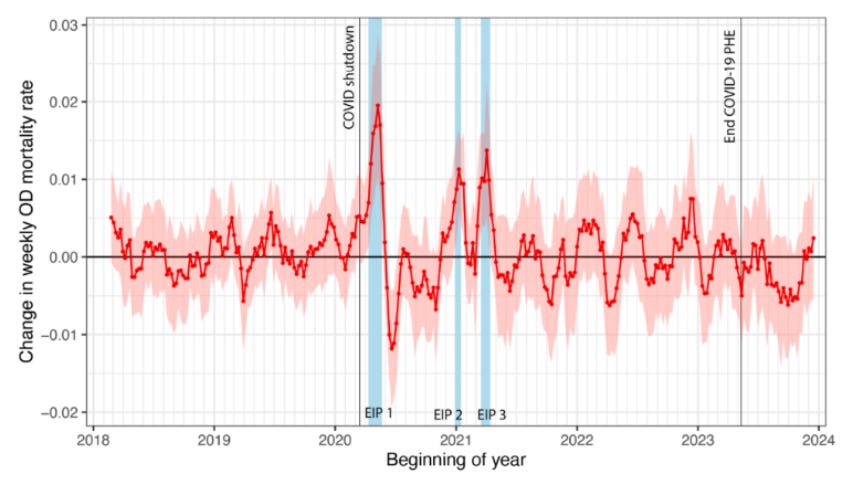
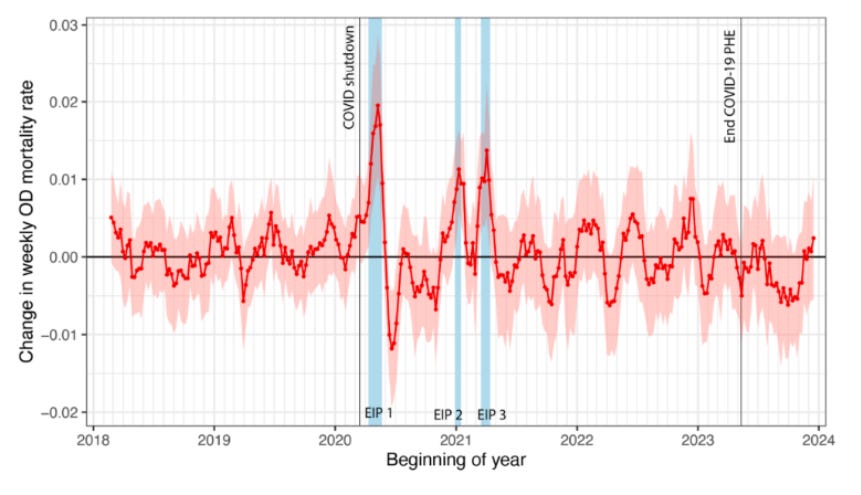
COVID Benefits Contributed to More Drug Overdoses. Although the cash payments issued by the federal government during the pandemic were “intended to alleviate economic distress,” Hawre Jalal and Donald S. Burke find that they “inadvertently contributed to overdose (OD) risk.” In a recent paper, they studied the effects of the Economic Impact Payments (IEPs) that the federal government gave to “broad swath(s) of the population regardless of employment status” in three rounds of payments between April 2020 and May 2021. These IEPs led to a phenomenon known as the “check effect,” wherein large or lump-sum payments lead to an “increase in substance use, hospitalization, and OD.” From March 2020 to May 2023, “OD deaths exceeded baseline by 67,571 (24.4 percent), with temporary spikes in ODs aligning closely with EIP disbursements. The authors estimate that “for each 10% increase in relative income, OD deaths increased by 11%,” suggesting a “harmful association between EIP disbursements and OD deaths.”