
In the Press: House Reconciliation Plan, SNAP’s Design Problem, Taxing Unrealized Gains, Government Equity Stakes, and Australia’s Retirement Model
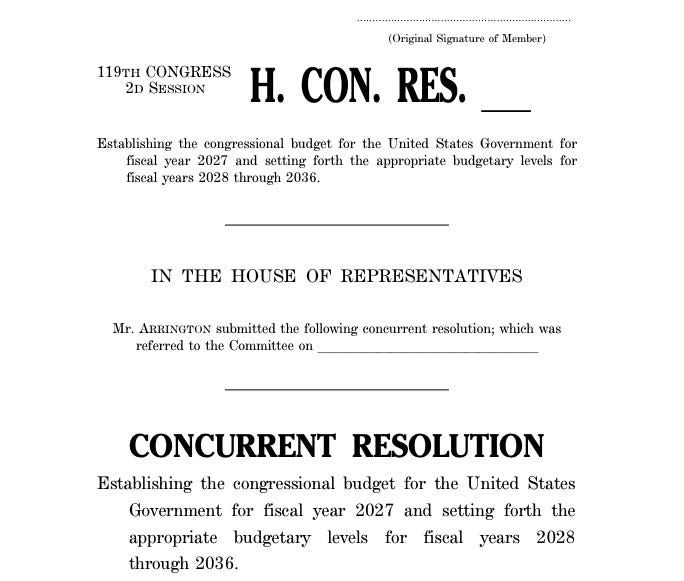
A Cato News Release reviews the House Budget Committee’s release of its Fiscal Year 2027 budget resolution. It paves the way for a third budget reconciliation bill that would generate more than $100 billion in deficits by authorizing more spending for defense and agriculture subsidies, without offsetting spending reductions. Boccia comments:
“Congress is wasting another opportunity to use reconciliation for what it should do: reduce deficits by cutting waste, fraud, and abuse in federal spending. Instead of making life more affordable by reforming bloated welfare and health care programs, lawmakers are using this powerful budget tool to finance another round of special-interest giveaways for the farm lobby and expand the defense apparatus—all on the nation’s credit card. Reconciliation should be about restoring fiscal discipline, not finding new ways to spend borrowed money.”
Fix Social Security with flat benefits
In The New York Times, Boccia responds in a letter to the editor to Senators Bernie Moreno and Elizabeth Warren’s case for scrapping the Social Security payroll tax cap:
“Rather than continually raising taxes to sustain ever-larger promises, policymakers should rethink the program’s purpose. A flatter benefit focused on basic retirement security, combined with greater reliance on private savings, would be more cost-effective and sustainable.”
SNAP’s design is prone to waste, fraud, and abuse
In Reason, Eric Boehm reports that more than $1 of every $10 in SNAP benefits went to ineligible recipients in 2025. He cites Boccia and Tyler Turman’s analysis on the program’s underlying flaw:
“The report confirms what has long been true: SNAP is structurally prone to waste, fraud, and abuse, and the states running it have too little financial incentive to fix it,” write Romina Boccia and Tyler Turman, a pair of budget policy experts at the Cato Institute.
Taxing unrealized gains would force Americans to sell assets just to pay the bill
In AMAC Newsline, David Catron argues that Gavin Newsom’s proposed national wealth tax would reach well beyond billionaires because it would tax unrealized capital gains. He cites Adam Michel, director of tax policy at the Cato Institute, who explains the core flaw:
“The core problem with taxing unrealized gains is that there is not actually anything to tax until the asset is sold for a profit. For example, if I purchase a house for $400,000 and it appreciates by $50,000 the following year—an unrealized gains tax at 25 percent would mean I owe the government $12,500, regardless of whether I sell the house or have the cash on hand to pay the bill. If you don’t have the cash, such a system would force you to sell your home or take out a loan to pay the government.”
When government takes equity stakes, firms serve politicians instead of customers
In The Washington Post, David J. Lynch reports that even as Trump attacks “communists,” his administration is expanding the government’s own role as an owner of private firms. He quotes Scott Lincicome on why that should worry free-market advocates:
That’s what worries Scott Lincicome, vice president of general economics at the Cato Institute, a libertarian think tank. Having the government act as an owner, rather than a regulator or tax authority, he said, distorts the economic playing field and leads to companies that aim to satisfy politicians, not customers or shareholders. Likewise, poor-performing government-backed companies that should be allowed to fail may instead be kept alive by regulatory preferences or other government favors, he said.
“Far from being a bulwark against creeping American communism, Trump is laying the groundwork for more of this in the future. The president himself has said that he thinks it’s very American to take these government equity stakes based on what the country needs. It’s almost comical how much that sounds like ‘seizing the means of production’ [or] ‘to each according to his needs,’” said Lincicome, referencing traditional Marxist lingo.
An Australian-style retirement system wouldn’t fix Social Security’s core problem
President Trump said he’s looking “very strongly” at adopting Australia’s compulsory retirement savings model, generating a wave of coverage that turned to Cato on why the idea sidesteps Social Security’s real problems.
In The Hill, Mallory Wilson reports that Trump wants to model a Social Security overhaul on Australia’s superannuation system. She quotes Boccia on the potential problems:
Romina Boccia, director of budget and entitlement policy at the Cato Institute, said if the U.S. were “starting from scratch,” Australia’s system could be beneficial.
“Because you would avoid the large unfunded liabilities that we have in the Social Security system, where the gap between what Congress has promised to seniors, and what it is expected to collect from workers now exceeds $30 trillion over the long term,” said Boccia. “So you don’t have that problem in the Australian system because it’s fully funded with savings and investments,” she added.
Boccia said a transition from the current system to one like Australia’s would mean more money would need to be taken from younger workers “to set up a private retirement account while still honoring the promises that have been made to current seniors.”
In Newsweek, Giulia Carbonaro examines what an Australian-style overhaul could mean for American workers and lays out Cato’s objections, drawing on Boccia and Nachkebia’s analysis:
The Cato Institute, a libertarian think tank, strongly opposes the introduction of an Australian-inspired retirement policy, believing it would create a “politicized sovereign wealth fund that expands governmental influence over markets.”
But its rejection is not on principles alone. Compulsory savings “would be an improvement over the current pay-as-you-go model by empowering workers with ownership over their forced contributions,” experts wrote in a December analysis, but “the catch is that doing so now would entail massive transition costs.”
In BizPac Review, Vivek Saxena reports on the same proposal, citing Boccia and Nachkebia’s analysis on why an Australian-style system would cost workers either way:
However, the [libertarian] Cato Institute has warned that adopting Australia’s approach would mean taking more money from people’s paychecks. “Compelling American workers to save on top of existing payroll taxes would displace voluntary savings and disproportionately harm low-income workers,” the institute notes.
The other option would be to divert a portion of payroll taxes into individual accounts. The problem with this is it’d skyrocket the debt and increase Social Security’s shortfall. “[D]iverting half of payroll taxes into individual accounts would increase Social Security’s 30-year shortfall by $50 trillion, exacerbating the already-dismal fiscal outlook and accelerating a debt crisis,” according to the Institute.
IBTimes similarly observed that Cato has argued the cost of compulsory contributions tends to fall on workers themselves, through fewer jobs or lower take-home pay.
Coverage also ran across iHeart stations, whose newsroom noted that critics including Cato caution against an expanded government role in retirement savings and its effect on workers’ earnings and voluntary saving.
Should Social Security Be Means-Tested? Lessons from Australia and New Zealand

This is a guest post by Michael Littlewood.