Here are this week’s reading links and benefits breakdowns:
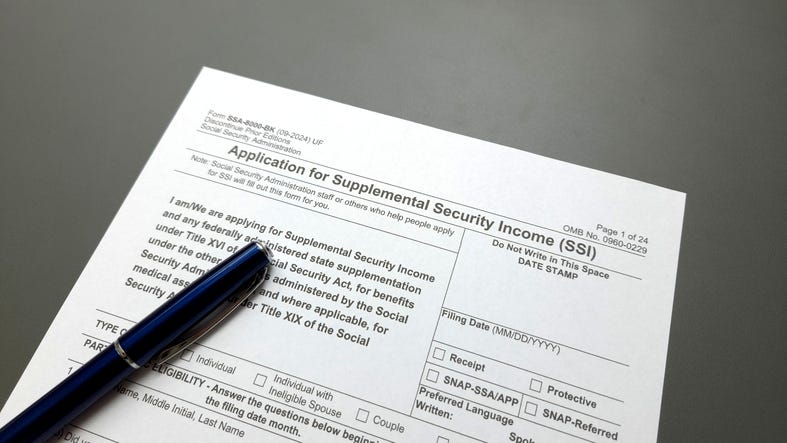
Outdated SSI Reporting Drives Billions in Overpayments. A new Social Security Advisory Board report from Amy Shuart, Nancy Altman, Jagadeesh Gokhale, and Bob Joondeph finds that outdated reporting infrastructure contributed to Supplemental Security Income (SSI) making $6.3 billion in overpayments in fiscal year 2024. As Cato scholars Romina Boccia and Tyler Turman highlight in their recent briefing paper, SSI's integrity problems stem in part from the Social Security Administration (SSA) not deploying automated verification tools, and its reliance instead on beneficiaries to self-report eligibility changes under complex rules that both they, and administrators, struggle to understand. The report’s findings reinforce this: “Upwards of ten million SSI changes per year must be manually processed by SSA technicians,” and most reporting channels “still center on paper mail, phone calls, faxes, and in-person visits.” Changes reported even a few days late cannot be corrected before benefits go out, and SSA's processing delays generate overpayments even when recipients report on time. Modernizing SSI’s reporting and verification systems would lower improper payments in the program, “reduce burdens on recipients and staff, and build a more responsive and accurate system.”
OBBBA Returns Elevated SNAP Spending to Pre-Pandemic Levels. The Supplemental Nutrition Assistance Program (SNAP) “was not cut” in last year’s reconciliation bill — “it was caught,” says Mercatus scholar Joshua Pauze in the Washington Examiner. Critics argue that the One Big Beautiful Bill Act (OBBBA)’s SNAP reforms are “stripping vulnerable households of crucial benefits,” citing an estimated $187 billion spending reduction over fiscal years 2025-34. But these reductions are overdue. Although “SNAP… [spending and caseload] expansions are expected in times of [economic] crisis,” by 2025, expenditures on the program remained well above 2019 levels despite labor markets recovering— reflecting both elevated enrollment and higher benefit levels. One reason for this was the Biden administration’s 2021 Thrifty Food Plan reevaluation, previously covered by the Debt Dispatch as an “unlawful, partisan entitlement expansion” that raised SNAP benefits by 21 percent without congressional approval. Framing SNAP enrollment and spending coming closer to pre-pandemic levels as a cut is “misleading,” Pauze says. “After the pandemic, SNAP outgrew its original intention. Congress, for once, decided not to let an emergency become an entitlement... In this case, the word ‘cut’ doesn’t cut it.”
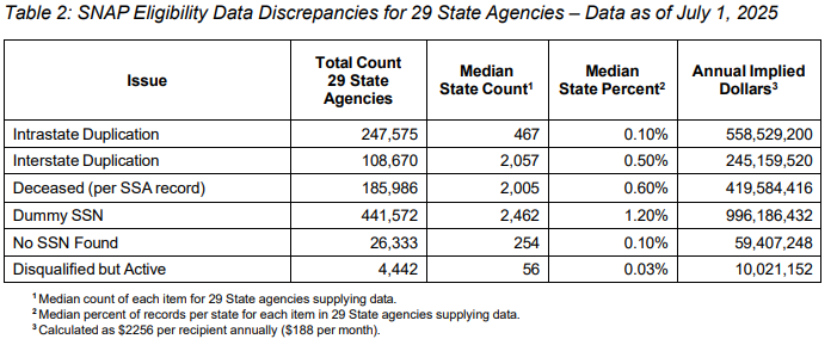
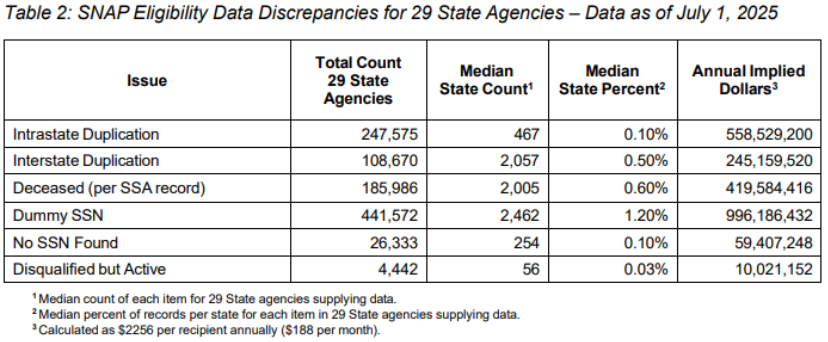
USDA Report Finds $3 Billion in Potential SNAP Misspending Across 29 States. A recent report from USDA’s SNAP Program Integrity Data Team “identified at least $3 billion a year of potential waste, fraud, and abuse” across just 29 of 53 state food stamp programs. USDA analyzed state SNAP records and cross-checked them against Social Security Administration data and other federal databases. Among the 29 states that provided data, USDA identified more than one million instances of duplicate enrollment, deceased beneficiaries, invalid or missing Social Security numbers, or recipients who had been disqualified but continued receiving benefits. Improper enrollments from these discrepancies alone cost federal taxpayers an estimated $2.2 billion in fiscal year 2025. As the report concludes, this indicates “that even small error rates can translate into substantial fiscal impact when applied across large caseloads… these results highlight the need for targeted oversight, improved data integrity efforts, and sustained collaboration with States to reduce vulnerabilities and ensure program accuracy.”
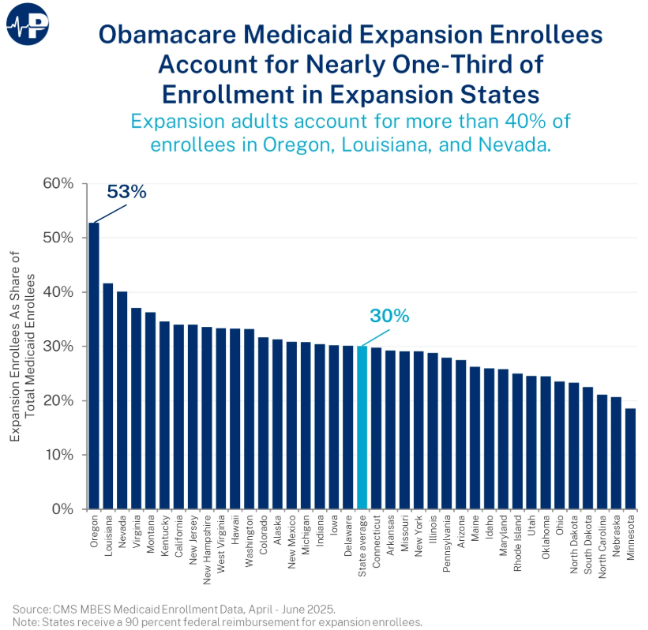
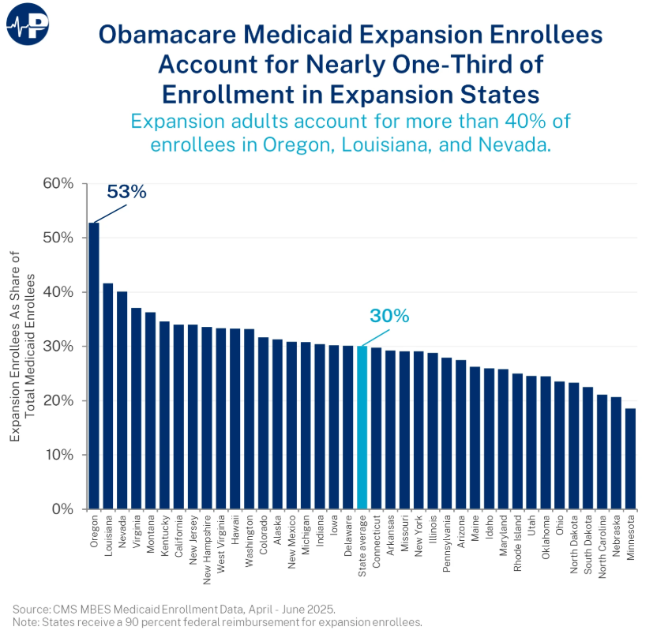
Able-Bodied Adults Drive Enrollment Surge in Medicaid Expansion States. “Healthy, working-age adults now comprise between one-quarter and one-half of all Medicaid enrollees” in many states, write Paragon Health Institute scholars Niklas Kleinworth and Atticus Vernacchio. “Medicaid was originally created to serve society’s most vulnerable Americans—pregnant women, children, seniors, and people with disabilities.” However, “Obamacare dramatically expanded the program to millions of able-bodied, working-age adults,” with “expansion adults [accounting] for roughly 30 percent of Medicaid enrollment in expansion states,” including 40 percent in Louisiana and Nevada, and more than 50 percent in Oregon. This trend, explain Kleinworth and Vernacchio, reflects the Medicaid expansion’s financing structure, which creates “powerful incentives” for states to maximize able-bodied enrollment by matching $9 for every $1 states spend on them. This dynamic has crowded out health care access for the traditional Medicaid population.
No Measurable Effects of Cash Transfers on Early Childhood Development. A new NBER paper challenges the argument for expanded child welfare programs, finding that unconditional cash transfers have no measurable effect on young children’s developmental outcomes. Researchers recruited 1,000 mothers with incomes below the poverty line shortly after giving birth and randomly assigned them to receive either $333 or $20 per month for their children's first several years. After four years, with high-cash families having received about $16,000, the authors “find no statistically significant impacts of the cash transfers” on any of the four primary measured outcomes for children, including language, ability to focus or switch between tasks, social and emotional development, and brain activity. As the authors conclude, the results “may indicate that cash income alone does not have a causal effect on young children’s development.”