Welfare Digest | New Medicaid Work Requirements At Risk of Being Gamed
Links & Benefits Breakdowns



Here are this week’s links and benefits breakdowns:
New Medicaid Work Requirements At Risk of Being Gamed. Earlier this week, the Centers for Medicare & Medicaid Services issued an interim final rule implementing the Medicaid work requirements for able-bodied adults enacted in the One Big Beautiful Bill Act. As the Paragon Health Institute points out, these requirements “represent a critical step toward restoring Medicaid to its original purpose: serving as a targeted safety net for the most vulnerable rather than an open-ended entitlement that discourages work and strains taxpayer resources.” However, as Paragon scholars Chris Medrano and Brian Blase write in The Federalist, some states are already “gearing up” to undermine the new work requirements by “[permitting] applicants… to self-attest” their compliance or if they have a condition that exempts them, such as medical frailty, “without verification.” Paragon warns that the requirements “must be effectively designed and enforced to minimize gaming and abuse. Self-attestation alone for compliance and exemptions—particularly for medical frailty—risks repeating the improper enrollment and fraud seen in other programs when verification standards were weakened.”
Congress Shouldn’t Create Another Newborn Benefit. Congress should not create another newborn benefit program to address rising costs of childrearing, writes AEI scholar Kevin Corinth. The recently introduced Supporting Newborn Parents Act of 2026 would create a newborn tax credit that provides families up to $2,000 per newborn child. This bill, as Corinth points out, would cost federal taxpayers more than $71 billion over the next decade and would “continue Washington’s habit of solving every problem by creating another program.” As Cato scholar Chelsea Follett argues, rather than creating new subsidies, Congress should address the regulations that make childrearing expensive in the first place. Childcare subsidies and “associated regulations on staffing and government standards of care often drive up the cost of provision, making childcare more expensive... A better approach to make raising a family more affordable,” she points out, “is to remove the misguided regulations that drive up the costs of raising a family.”
Ways and Means Advances Bill to Strengthen TANF Oversight. A new bill would address many of the Temporary Assistance for Needy Families (TANF) program’s longstanding integrity problems. As the Debt Dispatch has previously covered, many states have used TANF funds to plug budget shortfalls and direct millions of dollars toward initiatives with tenuous, or no, connections to the program’s goals. But the true scope of financial mismanagement in the program is unknown, because TANF is one of the few federal welfare programs not required to measure improper payments. Last month, the House Ways and Means Committee approved Representative Mike Carey’s (R-OH) Preventing Waste, Fraud, and Abuse in TANF Act (H.R. 8872). This bill would require Health and Human Services to measure improper payments for TANF every year and submit a plan to Congress for how it intends to eliminate them, prohibit states from using federal TANF funds to replace state or local funds, set a strict income threshold for program benefits at 200 percent of the federal poverty level, and place a 3-year period for states to spend TANF funds. These reforms would close some of TANF’s most glaring accountability gaps, help ensure funds reach the low-income families the program was meant to serve, and bring the program in line with oversight standards applied to other federal welfare programs.
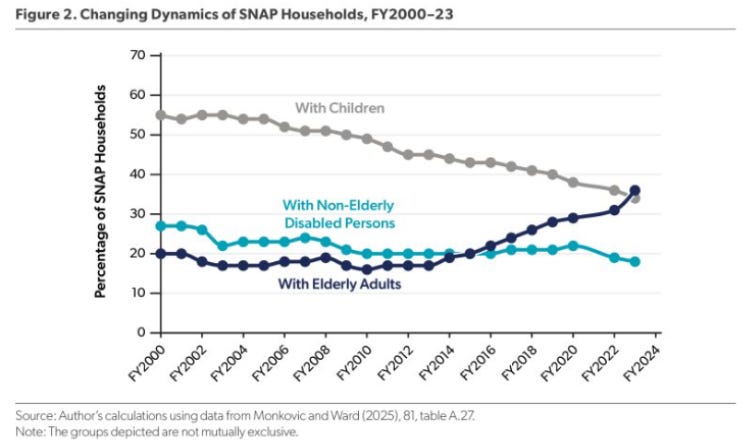
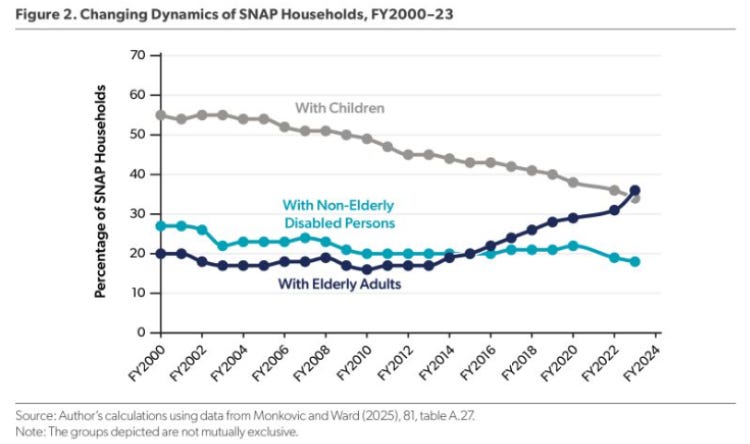
SNAP Serves More Elderly Households Than Families with Children. A recent paper by AEI scholar Angela Rachidi highlights that the Supplemental Nutrition Assistance Program (SNAP) has shifted from a program primarily serving families with children to one increasingly composed of elderly households. “In FY 2023, the share of SNAP households containing an elderly person (36 percent) exceeded the share containing a child (34 percent) for the first time.” Although an aging population is a partial explanation, this trend also “reflects evolving policy choices over the past 25 years” that treat households with elderly and disabled individuals differently than those without in several ways, such as uncapped deductions for medical and housing expenses and longer recertification periods. As a result, elderly and disabled households “qualify for SNAP at higher gross income levels and can receive a higher SNAP benefit” than others with the same gross income. If Congress seeks to further slow SNAP’s growth, it “must confront the realities of population aging and the past policy choices that today shape how elderly households increasingly qualify for and receive benefits.”
Trust in Government Programs Crowds Out Wealth Accumulation. A new NBER paper by Maya Haran Rosen, Annamaria Lusardi, and Olivia Mitchell finds that trust in government programs like Social Security, Medicare, and Medicaid crowds out private saving for retirement. Using survey data, the authors found that a one-unit increase in trust in government programs corresponds to a 4 percent lower probability of having a retirement account, a 6 percent lower likelihood of holding stocks, and $8,900 less in net household wealth. These findings, they say, “indicate a ‘crowding out’ effect: people who trust public programs more feel less compelled to save privately.” This effect is especially pronounced among Black and Hispanic respondents, who report higher trust in government programs than White respondents, but lower financial literacy and worse retirement outcomes overall. “This suggests that when people believe the government will care for them in retirement, they are less likely to save and invest in equity.”