Welfare Digest | More than Six Million Improper Obamacare Enrollees in 2026
Links & Benefits Breakdowns


Here are this week’s reading links and benefits breakdowns:
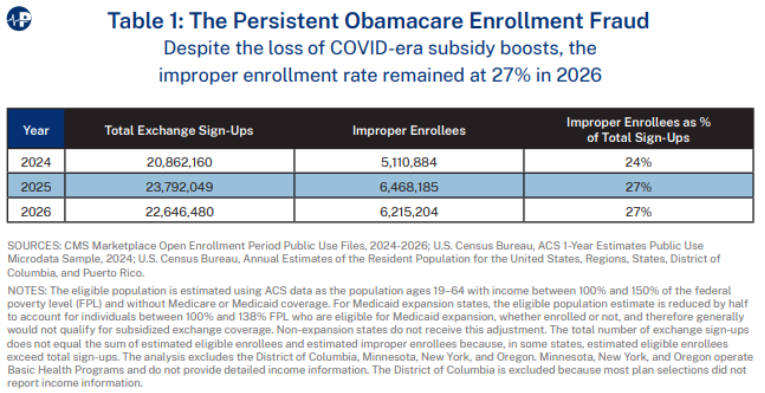
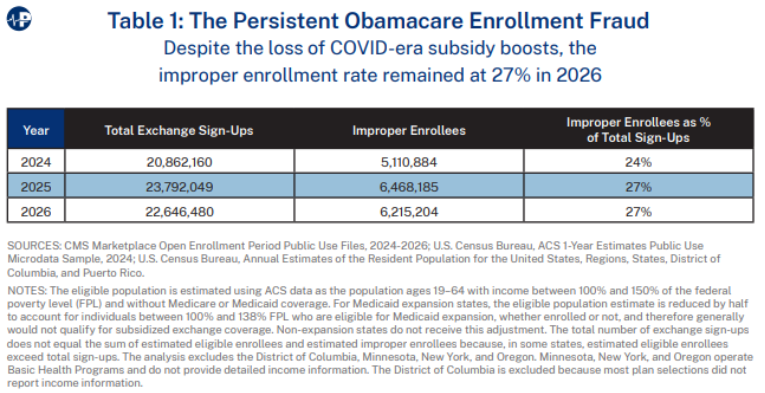
More than Six Million Improper Obamacare Enrollees in 2026. A new Paragon Health Institute paper finds that the Obamacare exchanges continue to be vulnerable to fraud. Paragon estimates that “more than one-quarter of all [Obamacare] exchange sign-ups are improperly claiming income between 100 and 150 percent of the federal poverty level (FPL) to receive the largest possible subsidy.” After comparing exchange sign-ups for those claiming income in the 100-150 percent FPL category to the total eligible population in that category using Census data, Paragon estimates that “approximately 6.2 million exchange sign-ups in 2026 were improper, representing roughly 27 percent of all exchange sign-ups.” They project that “taxpayers will fund up to $25 billion in improper subsidy payments… nearly one-quarter of projected [Obamacare] subsidy spending” this year. As they write, “although exchange enrollment declined modestly in 2026 [from 6.4 million in 2025],” the Obamacare exchanges “will continue to face program integrity challenges unless policymakers strengthen verification systems, reduce incentives for unauthorized enrollment activity, and improve oversight of enrollment intermediaries and outsourced enrollment platforms.” To learn more about the Obamacare exchanges’ fraud vulnerabilities and ways to address them, sign up for Paragon’s virtual event: “A Conversation About ‘The Persistent Obamacare Enrollment Fraud’ on June 23, from 1:30–2:30 p.m. EDT.
California's Medicaid Grift Exemplifies the Program’s Incentive Problems. California’s Medicaid exploitation exemplifies the program’s structural problems, argues the Wall Street Journal’s editorial board. The state bills Medicaid for services like tribal prayers, exorcisms, housing subsidies, gym memberships, music and art lessons, and even student loan repayments for health care workers. The program is also prone to fraud, with prosecutors “[charging] dozens of hospice providers with fraudulently enrolling Medicaid beneficiaries, some with stolen identities… the feds have [also] suspended payments to 800 hospice and home healthcare agencies suspected of fraud in Los Angeles” alone. The Trump administration paused $1.3 billion in Medicaid payments to California over fraud concerns last month, but “the underlying problem is that Medicaid’s design rewards states with more money when they waste money.” As the Debt Dispatch has previously covered, Medicaid’s open-ended matching grant structure has the federal government matching $1 to $9 for every dollar the states spend, rewarding overspending and weakening incentives to combat fraud. As the editorial board writes, “freezing Medicaid funds for profligate states is useful. But the grift will continue until Congress closes the open spending bar.” To learn more about Medicaid's structural weaknesses, their impacts on health care affordability, and two competing visions for reforming the program, register for the Cato Institute's Hill briefing “Fixing Medicaid’s Financing Structure to Reduce Waste, Fraud, and Overspending.” This panel, featuring Michael F. Cannon (Cato Institute), Chris Pope (Manhattan Institute), and Brian Blase (Paragon Health Institute), will occur at the 130 Cannon House Office Building on June 23, from 12:00 p.m. to 1:00 p.m. EDT.
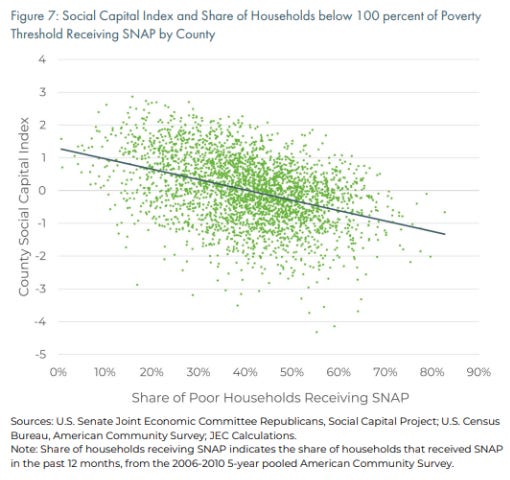
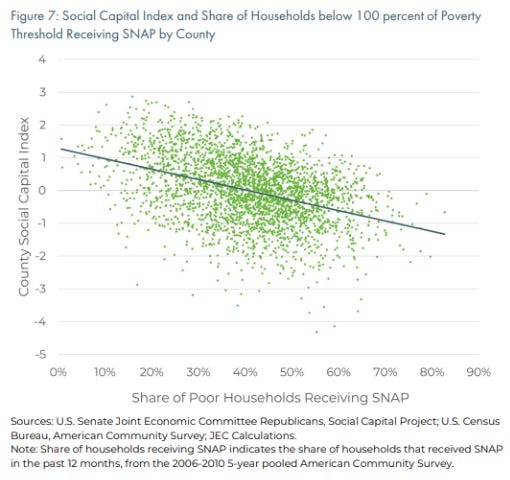
Counties with Stronger Social Ties Rely Less on Food Stamps. As Cato scholar Adam Michel previously wrote in a Joint Economic Committee (JEC) report, reliance on food stamps may weaken the social ties that help keep people out of poverty. Using a county-level Social Capital Index — a composite measure of Americans’ connections to family, community, faith, and work — the JEC found that counties with lower food stamp participation rates among households in poverty tend to have significantly stronger social capital. More than 70 percent of counties in the top decile of social capital are in the bottom third of food stamp participation. These findings are consistent with the JEC’s ‘crowd-out hypothesis’ that “people and communities that rely more heavily on government assistance for support will tend to have weaker connections to family and community.” Michel argues that “the most direct and cost-effective option lawmakers have to reverse the tide of receding social connection is to streamline and scale back the myriad [of] programs… that have accumulated over the past century.”
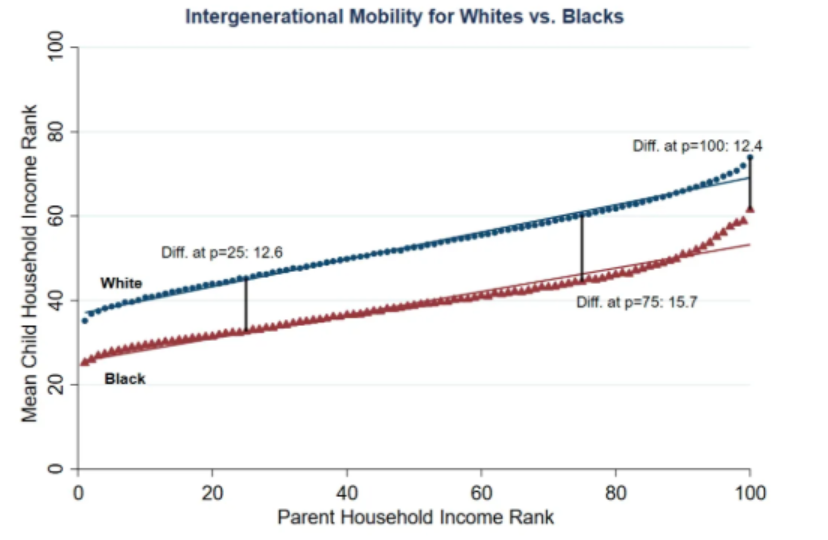
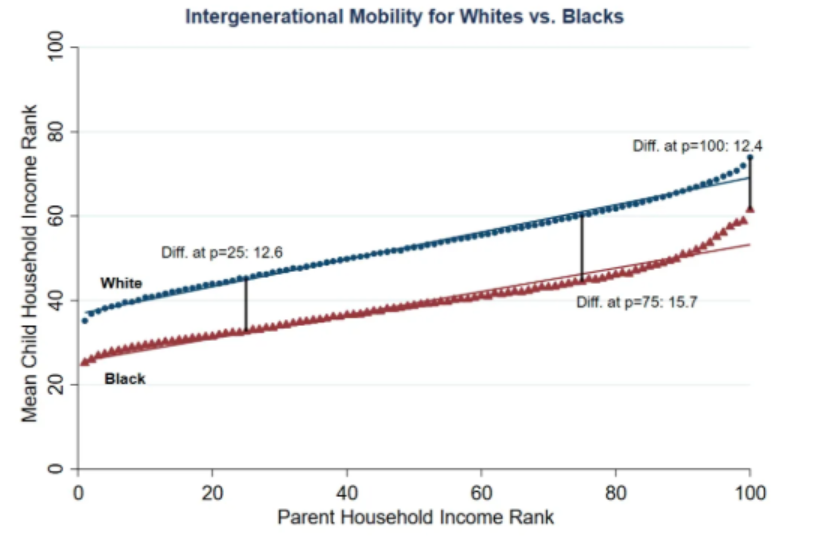
The Limits of Cash Transfers in Closing Racial Income Gaps. A recent post by economist Maxwell Tabarrok raises questions about whether government transfers are effective at narrowing racial intergenerational income gaps. He cites a paper by Raj Chetty, Nathaniel Hendren, Maggie Jones, and Sonya Porter that tracks intergenerational mobility—the link between where parents land in the income distribution and where their children end up—across racial groups from 1989 to 2015. As Tabarrok argues, if resource constraints limiting Black Americans’ access to “levers of social mobility like education, healthcare, and safe neighborhoods” were the main driver of racial income gaps, then transfers easing those constraints should shrink the gaps. Yet, as the paper points out, this racial disparity is the same size at every income level. For example, says Tabarrok, “the children of Black parents at the 99th percentile of national income, with access to the most expensive housing, healthcare, and education, have the same expected income as the children of white parents at the 75th percentile.” This suggests that “straightforward transfers,” like cash subsidies, “will not close” racial gaps in intergenerational mobility “because they aren’t caused by resource constraints.”
End the Community Development Block Grant. The federal government distributes roughly $3 billion each year to states for community and economic development activities through the Community Development Block Grant (CDBG). As the Debt Dispatch has previously covered, the CDBG is a “wasteful, failed program” that “breeds cronyism and drifts far from its purpose.” David Ditch of the Economic Policy Innovation Center, citing the Debt Dispatch’s work on the subject, points out that “the Community Development Fund was created as a welfare program to benefit high-poverty neighborhoods but is now primarily used to fund pork earmarks and local government responsibilities with little regard to a locality’s economic health.” If Congress needs ideas for curbing wasteful welfare spending, following through on the Trump administration’s request to eliminate this long-running failure is a good place to start. Representative McClintock (R-CA)’s Repeal Community Development Block Grants Act (H.R. 1133) would accomplish this by eliminating all CDBGs.