
Welfare Digest | Cato Scholars Highlight Proposed OMB Rule to Improve Federal Payment Screening
Links & Benefits Breakdowns



Here are this week’s reading links and benefits breakdowns:
Cato Scholars Highlight Proposed OMB Rule to Improve Federal Payment Screening. The Office of Management and Budget proposed a rule that would expand the use of the Treasury’s Do Not Pay (DNP) system. As the Debt Dispatch has previously covered, DNP is a data-matching tool that cross-checks applicant eligibility against federal databases before funds are disbursed. However, only 4 percent of eligible federal programs fully utilize DNP, and many state agencies lack access to the tool. The rule would address these shortcomings by requiring federal agencies to verify recipient eligibility through DNP before issuing payments, and by requiring state agencies administering federal programs to conduct pre-payment verification checks through DNP or alternative screening processes. As Cato scholars Romina Boccia and Tyler Turman point out in a recent comment in response to the proposal, OMB’s rule would “strengthen the integrity of federal programs by improving verification standards, reinforcing federal oversight, and expanding federal and state agencies’ access to [DNP],” which has “demonstrably proven to identify, prevent, and recover improper payments.”
Medicaid Work Requirements Can Lift Millions Out of Poverty. Medicaid work requirements could drastically reduce poverty and increase family incomes, according to a recent report by Danielle Berman et al. Last year’s reconciliation bill introduced work requirements for able-bodied, working-age adults on Medicaid. The authors analyzed how many people subject to those requirements could comply with them, and how doing so would affect their incomes and poverty status. They concluded that the “Medicaid work requirements included in the Working Families Tax Cut of 2025 could increase family net income by $12,034 and reduce poverty by 1.6 million to 2.9 million [people], thereby promoting economic mobility and strengthening labor force participation.”
Able-Bodied Recipients’ Incomes Often Double or Triple After Leaving Food Stamps. SNAP’s caseload decline is a “profoundly good thing” for both food stamp recipients and taxpayers, writes Foundation for Government Accountability (FGA) scholar Hayden Dublois for the Washington Examiner. As he points out, “food stamps were created for the truly vulnerable,” but lax eligibility standards allowed non-disabled adults to “enroll en masse.” By late last summer, “more than 8.1 million… able-bodied adults without young kids,” 70 percent of whom didn’t work at all, were on the program. The expanded SNAP work requirements from last year’s reconciliation bill, he says, reversed this trend. “Far from being kicked from the program for no good reason, able-bodied adults are getting jobs and making too much money to get the taxpayers’ help.” Dublois cites FGA’s research showing that able-bodied recipients’ “incomes double or even triple shortly after leaving food stamps.” He concludes that SNAP’s work requirements are “protecting food stamps for the truly vulnerable” while helping those capable of work climb “the ladder of opportunity.”
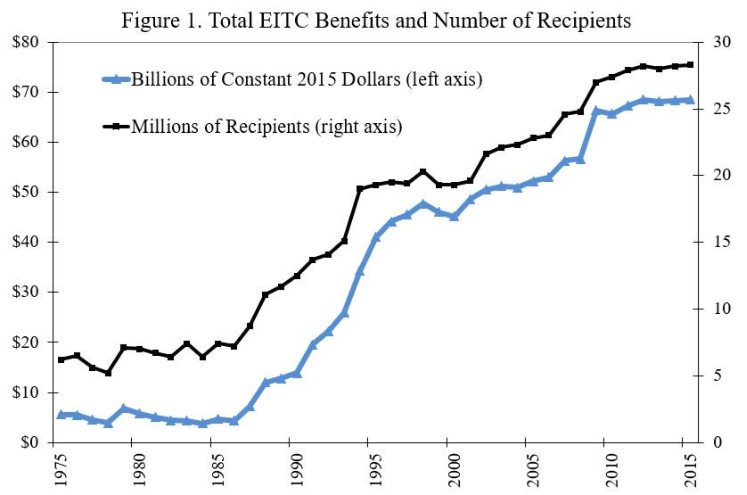
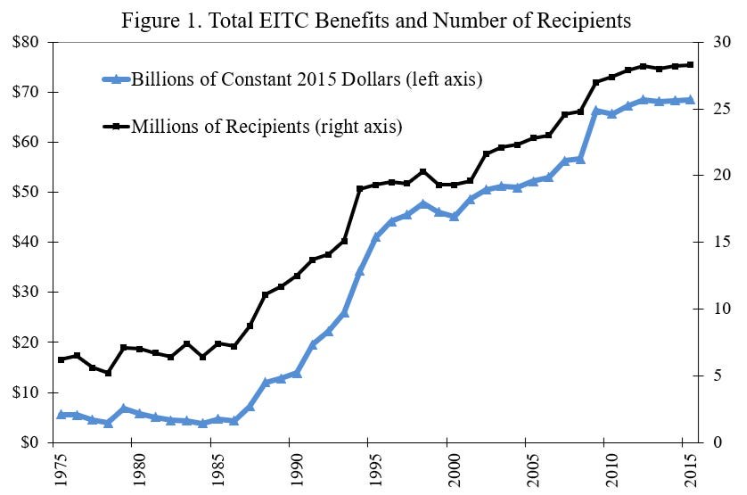
The EITC’s Overblown Pro-Work Record. A new paper challenges the narrative about the Earned Income Tax Credit (EITC)’s efficacy in promoting work among low- to moderate-income Americans. As Mercatus scholar Veronique de Rugy and Cato scholar Chris Edwards have written, “supporters of the EITC often point to the strong gains in [workforce] participation of single mothers in the late 1990s,” after the program’s expansion in 1993, as “evidence of the EITC’s benefits. But while the number of EITC recipients soared between 1987 and 1994, the number was flat in the late 1990s… precisely the years that labor force participation by single mothers was growing strongly,” suggesting that other factors drove the employment rise. Edwards and de Rugy’s findings are affirmed by Brookings scholar Adam Looney’s recent paper, which, after controlling for the effects of the 1996 welfare reforms, found that the employment effects of the EITC “[fell] to zero… The results imply that welfare reform, rather than the EITC expansion, drove the employment gains of the 1990s.” As de Rugy writes, the EITC’s supposed successes as a pro-work program are “thinner than advertised.”
Housing Vouchers Don’t Improve Children’s Life Outcomes. Housing vouchers don't meaningfully improve socioeconomic outcomes for children, argues economist Maxwell Tabarrok. One argument for low-income housing programs, as Brian Jacob, Max Kapustin, and Jens Ludwig note, is that better housing conditions reduce crime while improving children’s health and educational outcomes. To test this hypothesis, the authors studied a 1997 Chicago lottery experiment in which impoverished families, largely headed by unmarried African American women with children attending highly disadvantaged public schools, received vouchers worth $12,000 a year. As Tabarrok points out, the outcomes the authors tracked for children whose parents won a voucher were indistinguishable from those who didn’t: “Test scores, high school graduation rates, crime rates, and hospital visits are unchanged.” Recipients themselves also did not “move to neighborhoods with lower crime, lower poverty, better schools, or higher social capital.” As the authors of the paper conclude, “housing vouchers may not be the most efficient way to improve the long-term outcomes of poor children.”
Curbing Waste, Fraud, and Abuse in Federal Welfare Programs

Congress is gearing up for another potential reconciliation bill. If it moves forward, Congress should pursue reforms that curb waste, fraud, and abuse in federal welfare programs.