
Welfare Digest | Delaying SNAP Accountability Is the First Step Toward Eliminating It
Links & Benefits Breakdowns


Here are this week’s reading links and benefits breakdowns:
Delaying SNAP Accountability Is the First Step Toward Eliminating It. “Once Congress establishes a precedent for delaying [SNAP] accountability, it becomes easier to delay it again, or for a future Congress to abandon the measure altogether,” warns Cato scholar Romina Boccia. As Grace Yarrow reported for POLITICO, Senate Agriculture Democrats rejected a farm bill draft last week that would’ve delayed the SNAP cost-sharing requirements for states with high payment errors for one year, to FY 2029. “Democrats stood united” against the package, “sticking to their demand for a two-year delay,” to FY 2030 instead. Boccia notes that Democrats’ refusal is less a negotiating posture than a strategy: FY30 begins on October 1, 2029, which “would effectively hand a future Democratic administration a window to repeal the requirements before they take effect.” As the Debt Dispatch has previously written on the topic, “Congress should not use the Farm Bill to compromise on its commitment to combating waste, fraud, and abuse in SNAP. If reform is on the table, Congress should build on the progress it made last year, not undermine it.”
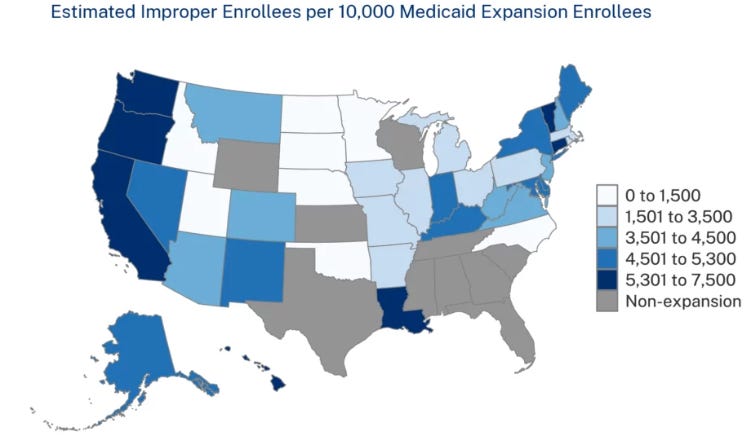
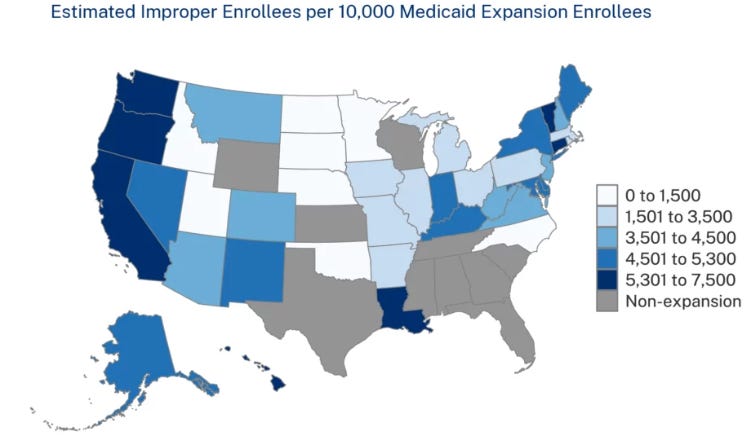
Nearly Half of Medicaid Expansion Enrollees Are Likely Ineligible. “Improper enrollment in Medicaid expansion is widespread, and it has grown dramatically worse since 2019,” writes Liam Sigaud in a new Paragon Health Institute report. Sigaud estimates that “9.2 million expansion enrollees—nearly half (46 percent)—were likely ineligible for the program in 2024. That is an 88 percent increase from the 4.9 million improper enrollees… estimated for 2019.” Improper Medicaid expansion enrollment “cost the federal government approximately $32.9 billion in 2024.” As Sigaud explains, because federal taxpayers match $9 for every $1 states spend on able-bodied Medicaid enrollees, “states bear almost none of the cost of improper expansion enrollment.” Policymakers, Sigaud says, can address this by reducing the “federal matching rate for expansion enrollees to the rate states receive for traditional enrollees.” But ideally, as the Debt Dispatch has covered, Congress should end the perverse incentives in Medicaid’s matching grant system altogether by converting the program into a fixed block grant.
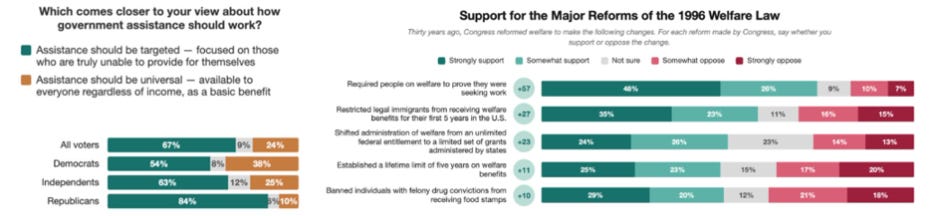
Americans Want a Targeted, Work-Based Welfare State. A new Manhattan Institute poll finds that Americans “generally favor assistance that is targeted toward those most in need [and] encourages work and self-sufficiency,” and don’t want to pay more to expand it. By an overwhelming majority, “67% to 24%, respondents say government assistance should be focused on those who are truly unable to provide for themselves rather than made available universally as a basic benefit.” Voters are also skeptical of the fiscal tradeoffs of expanding the welfare state, “with just 10% of voters supporting raising taxes to pay for more generous benefits.” This is consistent with the poll’s findings that “the principles that reshaped the nation’s welfare system of the 1990s”—namely, promoting work and independence, tightening eligibility standards, and time limits for benefits—still resonate with American voters.
Welfare Reform Cut Dependency, Other Programs Reversed It. Open-ended entitlement growth has undermined much of the progress the 1996 welfare reforms made in reducing dependency on cash assistance, writes AEI scholar Matt Weidinger. “The number of adults collecting welfare checks… has declined by 85 percent” since the creation of the Temporary Assistance for Needy Families (TANF) block grant. However, “remaining open-ended federal entitlements like food stamps, Medicaid, several refundable tax credit programs, and recent welfare-like unemployment checks grew rapidly in both spending and number of recipients.” As Weidinger notes, “some of that growth resulted from liberal policy expansions specifically designed to thwart the pro-work lessons of the 1996 law.” Rather than undo the progress made by the 1996 welfare reforms, Weidinger recommends that Congress “expand those reforms by further strengthening work incentives, applying time limits to reduce dependence, and holding states financially accountable for achieving better outcomes.”

Federal Subsidies Reward Low-Quality Nursing Home Care. Federal Medicare and Medicaid programs are enabling chronic neglect at nursing homes by continuing to fund providers regardless of care quality, argues Cato scholar Michael F. Cannon in the Washington Examiner. Cannon draws on numerous examples from a recent investigation into deadly neglect at facilities operated by Ensign Group, the largest owner of federally certified nursing homes, which derives most of its revenue from federal taxpayers. Residents died after staff failed to respond to calls for help; others suffered from maggot infestations; Ensign “paid $47 million last year to settle claims that it defrauded Medicare and Medicaid, yet those programs keep paying the company,” even giving an ant-infested facility a five-star rating. “The problem,” Cannon explains, “is that the government rewards low-quality care where market competition would not,” because providers wield disproportionate influence over the very quality controls designed to discipline them. This “[ensures] that low-quality providers can keep drawing government subsidies.”
