
Debt Digest | PROMISE Act Seeks to Advance Action on Social Security
Links & Fiscal Facts


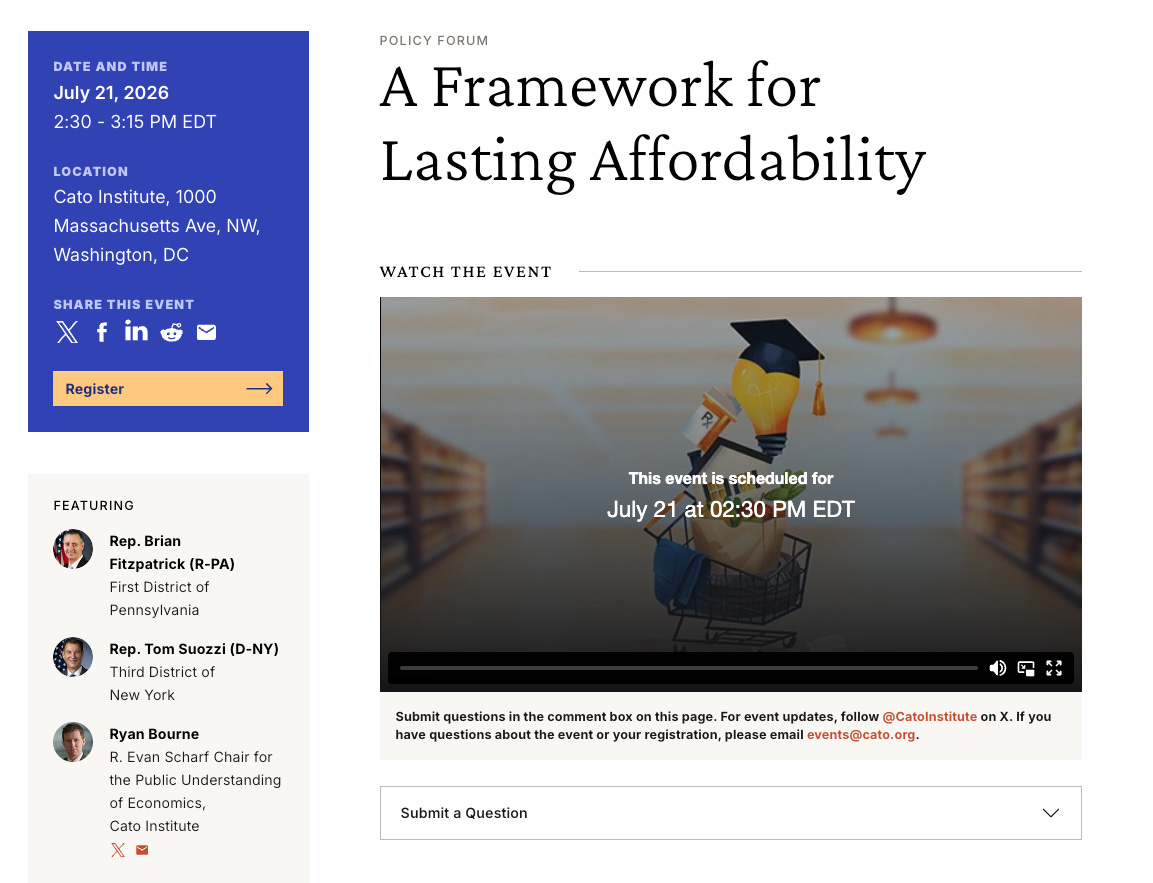
📢 Join Cato tomorrow, July 21, for A Framework for Lasting Affordability. From 2:30–3:15 PM ET in-person and online, Cato’s Ryan Bourne sits down with Problem Solvers Caucus Co-Chairs Reps. Brian Fitzpatrick (R‑PA) and Tom Suozzi (D‑NY) to dig into the caucus’s bipartisan Affordability Agenda. The Caucus should look for inspiration from Cato’s Handbook on Affordability to expand economic freedom, remove unnecessary regulatory barriers, and increase competition. Among those, Boccia and Lett’s fiscal policy contribution emphasizes the importance of reducing federal debt through a BRAC-like commission to make life more affordable for American families. Register here to attend in person, or catch the livestream on the event page.
Here are this week’s reading links and fiscal facts:
PROMISE Act seeks to advance action on Social Security. Senators Bill Cassidy (R-LA), Dick Durbin (D-IL), Thom Tillis (R-NC), Tim Kaine (D-VA), John Cornyn (R-TX), and Angus King (I-ME) introduced the PROMISE Act, which would have the independent Social Security Advisory Board transmit a 50-year solvency plan and fast-track it through Congress to a guaranteed floor vote, forcing action before the trust fund’s projected 2032 depletion triggers an automatic 22 percent benefit cut. Boccia comments: “For too long, Congress has treated Social Security’s rising shortfall as a future problem for someone else to solve. […] A process that requires Congress to debate and vote on a comprehensive solvency plan is a critical step toward dealing with the shortfall head on. As Cato polling demonstrates, the American people support a Congress willing to put politics aside to confront fiscal reality before a preventable crisis forces far more painful choices.” That polling finds 71 percent of Americans favor creating a commission of independent, nonpartisan experts to address the program’s funding shortfalls.
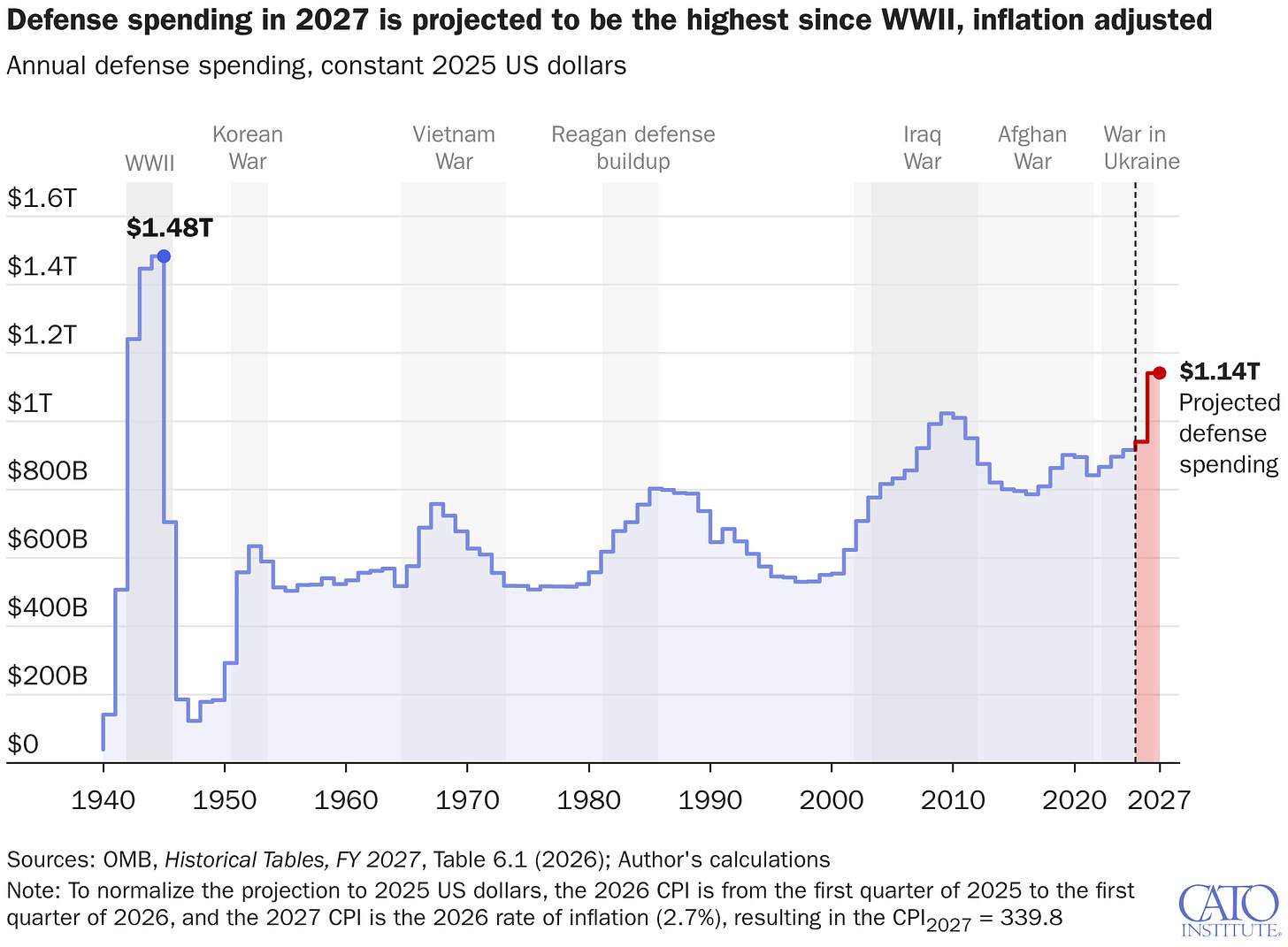
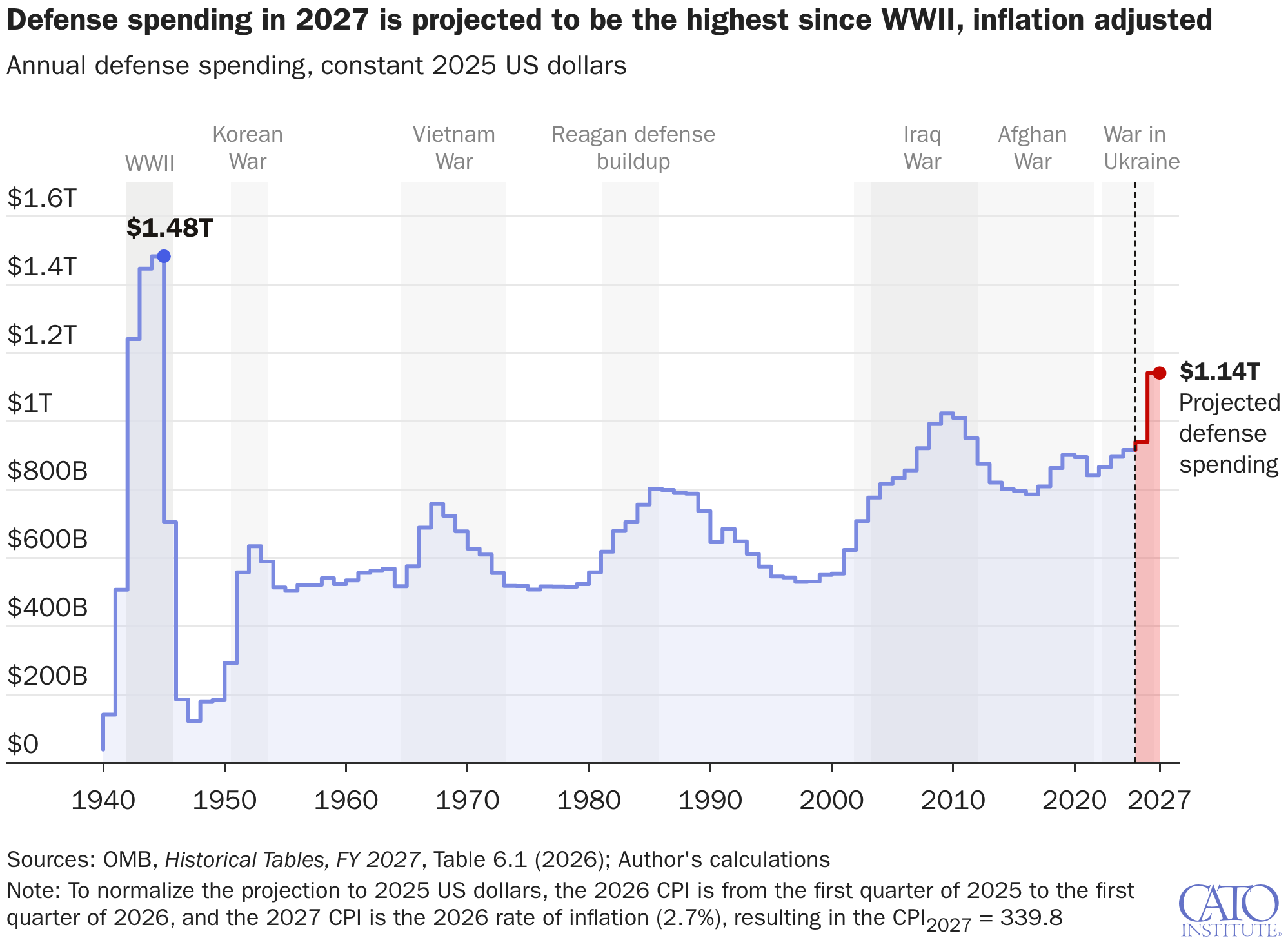
Record defense spending won’t fix the Pentagon’s structural flaws. Cato’s Katherine Thompson and Benjamin Giltner argue that the roughly $1.15 trillion FY27 National Defense Authorization Act “will largely preserve a wasteful and broken defense industrial base.” As the figure below shows, “adjusting for inflation, the United States will spend more on defense than it did at the heights of World War II, the Vietnam War, and the Reagan defense buildup.” Yet more money, they warn, is “the easy way of avoiding confrontation with systemic issues that arise in the procurement of high-value, high-cost weapons systems.” Thompson and Giltner call instead for right-sizing the topline and pursuing cost-cutting reforms: “Throwing more money at the defense industrial base may ostensibly seem like an easy solution, but a facade won’t solve deeper structural flaws.”
The federal budget process is built to overspend. Former Treasury official James Carter writes in American Thinker that runaway deficits are no accident: “This happened by design — the design of a federal budget process that systematically rewards spending and punishes restraint.” With federal spending “nearly 58 percent higher than in fiscal year 2019,” he calls it “a structural failure, one baked into the process itself.” Carter highlights new bipartisan legislation, the Budgeting for a Better America Act, which would move Congress to a biennial budget, stand up a fiscal commission charged with cutting the annual deficit to 3 percent of GDP within a decade, and force new transparency on debt costs. But he warns the fix is incomplete: “Commissions recommend. Congress decides. And Congress has a long history of deciding to do nothing,” and “any reform that ultimately sidesteps mandatory spending is not a complete reform.” Boccia explains what the missing enforcement looks like — a fail-safe, BRAC-style commission whose recommendations take effect through “silent approval,” a mechanism that “flips the default from paralysis to action, while still preserving Congress’s ultimate authority to say no.”
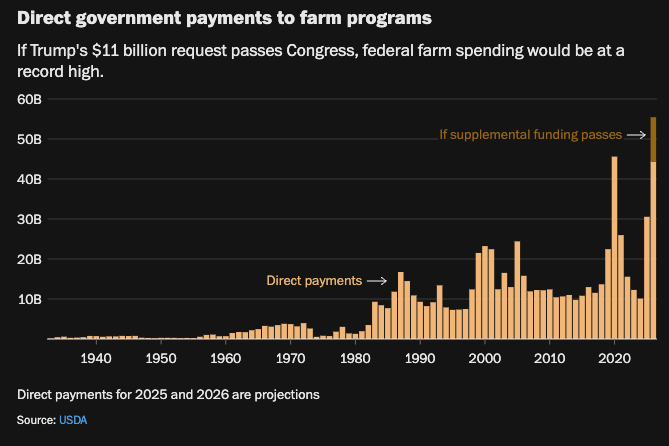
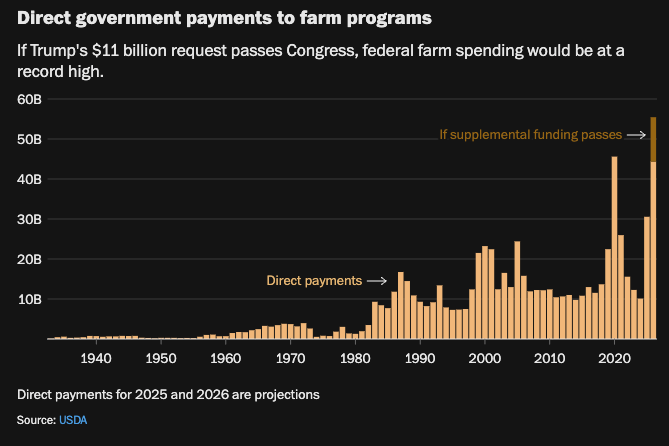
Washington is compensating farmers to offset Trump’s own policies. The WaPo editorial board writes that “American farmers can expect a bumper crop this year in corn, soybeans and, most of all, federal handouts.” It notes a “projected $44 billion of federal dollars that will go to farmers by the end of 2026 — more than a fourth of estimated net farm income,” and “Donald Trump proposes another $11 billion in his latest supplemental request to Congress to help farmers deal with the economic effects of the U.S.-Israeli war with Iran.” Furthermore, “Most of the subsidies are intended as compensation for the White House’s own policies,” yet they “go beyond cushioning farms in a rough period,” since “net farm income is still above the 20-year average.” Cato’s Chris Edwards echoes the diagnosis, noting the December “$12 Billion Farmer Bridge Payments” addressed disruptions that “were caused by Trump’s protectionist trade policies.” He sets the handouts in a bigger pattern: “no industry is more coddled by the federal government than agriculture,” and “most welfare programs are for low-income families, but farm welfare is for high-income families.”
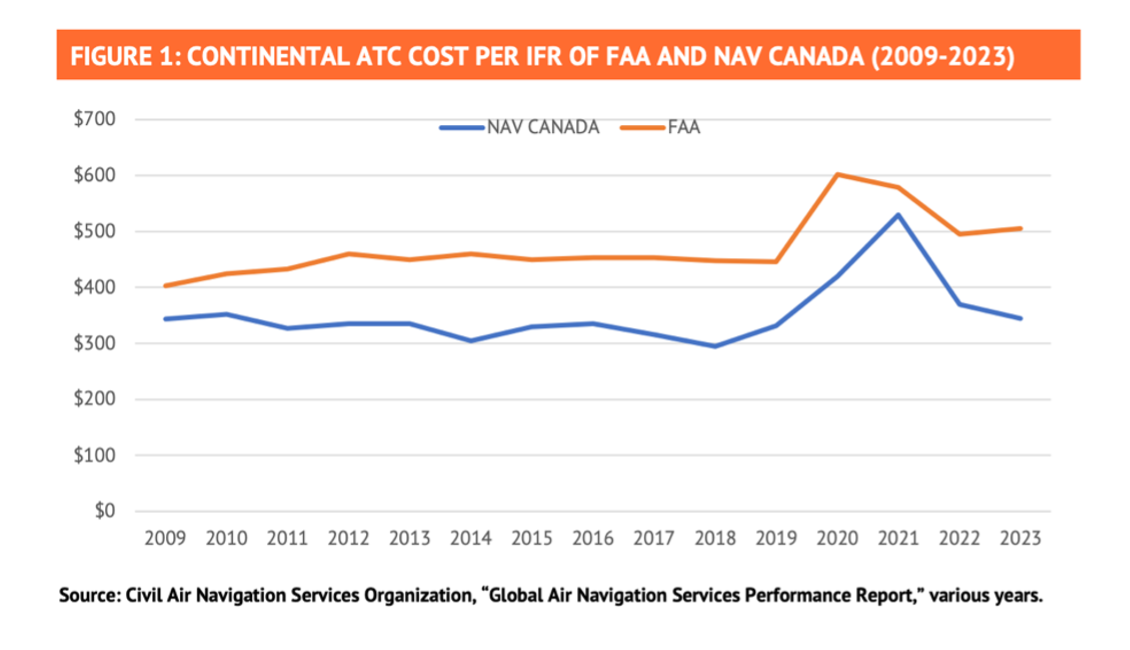
Canada’s self-funded model shows how to fix U.S. air traffic control. In a new Reason Foundation study, John Kefaliotis argues that “the U.S. air traffic control system is embedded in a tax-funded bureaucracy that is unable to replace ancient facilities and obsolete technology,” dependent on annual appropriations from Congress. Canada broke from that model in 1996, spinning its air traffic organization out of the transport ministry into NAV CANADA, a self-funded nonprofit run on the principle that “users pay, users say.” The results: FAA costs to manage continental airspace ran “8% to 34% higher than NAV CANADA’s, averaging 25% through the 15-year period,” while “the not-for-profit commercial model enables steady, user-funded investments without annual budget battles, allowing faster technology adoption and infrastructure renewal than the government model.” When COVID cratered traffic, the structure let NAV CANADA “weather such events without exposing taxpayers to risk.” Cato’s Chris Edwards echoes the case, arguing Congress should “separate ATC operations from the dysfunctional federal government.”

Canadians are screwing up their country in rather monumental ways these days, from sending us the result of their poor forestry practices to their suicidal (no pun intended) Medical Assistance in Dying (MAiD) program, their failing "Medicare for All" health system, their assaults on freedom of speech, and deficit spending that is getting out of control (as if any American should talk). But they've done two things right: privatizing their air traffic control system and, 31 years ago, reforming their food safety system with a single food safety inspection regime. We should pay attention to both.