Debt Digest | Let The Temporary Medicare Part D Subsidies Expire
Links & Fiscal Facts


Here are this week’s reading links and fiscal facts:
Senate FY 2027 Budget Resolution To Expand Deficits By More Than the House. On Friday, the Senate Budget Committee released the text of a FY 2027 budget resolution with the stated purpose of facilitating a reconciliation package (a fast-track mechanism intended for deficit reduction). As with the resolution that the House passed on July 22, the Senate’s reconciliation instructions aim for deficit increases rather than decreases. Worse, while the House budget would allow a total deficit increase of $95 billion, the Senate budget provides instructions to more committees and would allow up to $150 billion in deficit increases. Both resolutions would provide $60 billion for defense, $12 billion for farm subsidies, and $13 billion for intelligence, Notable additions in the Senate resolution include $20 billion for Homeland Security, and $20 billion for the Judiciary committee. The Senate resolution would provide $20 billion for spending related to elections, up from the House resolution’s $10 billion. Congress failed to provide net deficit reduction in the FY 2025 and FY 2026 reconciliation packages. It now appears that Congress will worsen deficits in FY 2027 as well.
Let the temporary Medicare Part D subsidies expire. The Washington Post editorial board argues the Trump administration is right to end the temporary Part D premium stabilization subsidies at the end of 2026. The subsidies, which go to private insurers to offset premium increases, are estimated to cost nearly $10 billion across 2025–26 and have shifted a larger share of program costs onto taxpayers—who now shoulder 87 percent. They conclude, “shoveling ever more taxpayer money into a market the government broke does not actually make health care more affordable. Restoring some cost consciousness for Part D beneficiaries is good for the program overall.”
Federal ownership stakes in AI firms would let Washington pick the winners. Cato’s Jennifer Huddleston and Tad DeHaven argue that “claiming a piece of the AI industry outright would mark a dramatic escalation in Washington’s burgeoning push to take ownership stakes in private companies.” President Trump is exploring a public financial stake, and Sen. Bernie Sanders (I-Vt.) would have the government own half of the largest AI firms. Huddleston and DeHaven warn, “today’s AI ownership proposals would make Washington an owner of cutting-edge companies as a matter of policy.” The result: “a government that is simultaneously regulator, shareholder and policymaker in the AI industry — hardly a neutral referee.” They conclude, “The greatest risk to AI isn’t so much that government fails to pick the right winner but that it gets the power to pick them at all.”
Every major Social Security law was developed with help from a commission. Marc Goldwein of the Committee for a Responsible Federal Budget testified before the Senate Finance Committee, urging lawmakers to establish “a special bipartisan process to help reach agreement on a solvency package before it is too late.” He notes that “from Social Security’s origin, the most significant Social Security laws were all developed with the help of commissions or advisory councils,” including the Greenspan Commission, whose 1983 reforms “restored the program to solvency for 50 years.” He points to the success of the BRAC commission: “Some, like the Base Realignment and Closure (BRAC) commission, had their recommendations enacted in full.” Boccia makes the case for a BRAC-like fiscal commission in her statement for the record, as its “defining features, insulation from politics and fast-track authority, give it a far greater chance of succeeding where previous commissions with similar goals have failed.”
The IRA’s drug provisions meant to reduce deficits increased them instead. A new Congressional Budget Office letter reports that in September 2022 they “projected that enacting those provisions would lead to combined deficit reductions of $129 billion over the 2022–2031 period” — but “on the basis of new information,” CBO “now projects that those provisions will combine to increase deficits.” Drug-price negotiation and inflation-rebate savings came in smaller than expected, while “the costs of the Part D redesign have been significantly larger.” For 2026, plans anticipated a 35 percent jump in per-enrollee costs against the “roughly 5 percent” CBO had expected. Part D outlays over 2026–2035 now total “$2.1 trillion, up from $1.5 trillion in the January 2025 baseline.” House Budget Committee Chairman Jodey Arrington (R-TX) comments: “We have once again confirmed that Democrats, with CBO’s analysis in hand, sold the American people a false bill of goods in the Inflation Reduction Act. Combined with the Joint Committee on Taxation’s $600 billion miscalculation of the cost of the Green New Deal tax credits, we now know the IRA cost Americans $1.3 trillion more in new deficit spending.”
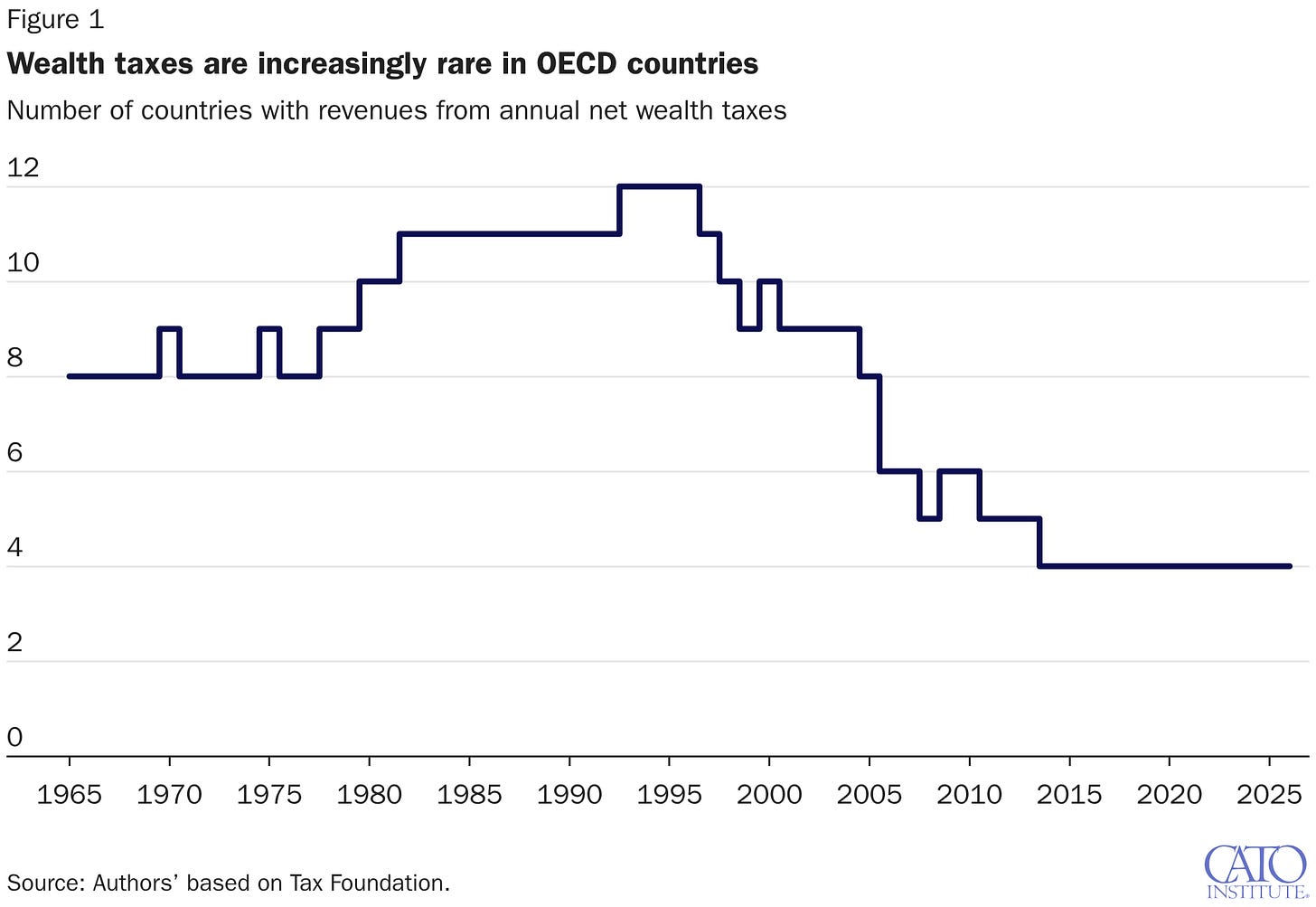
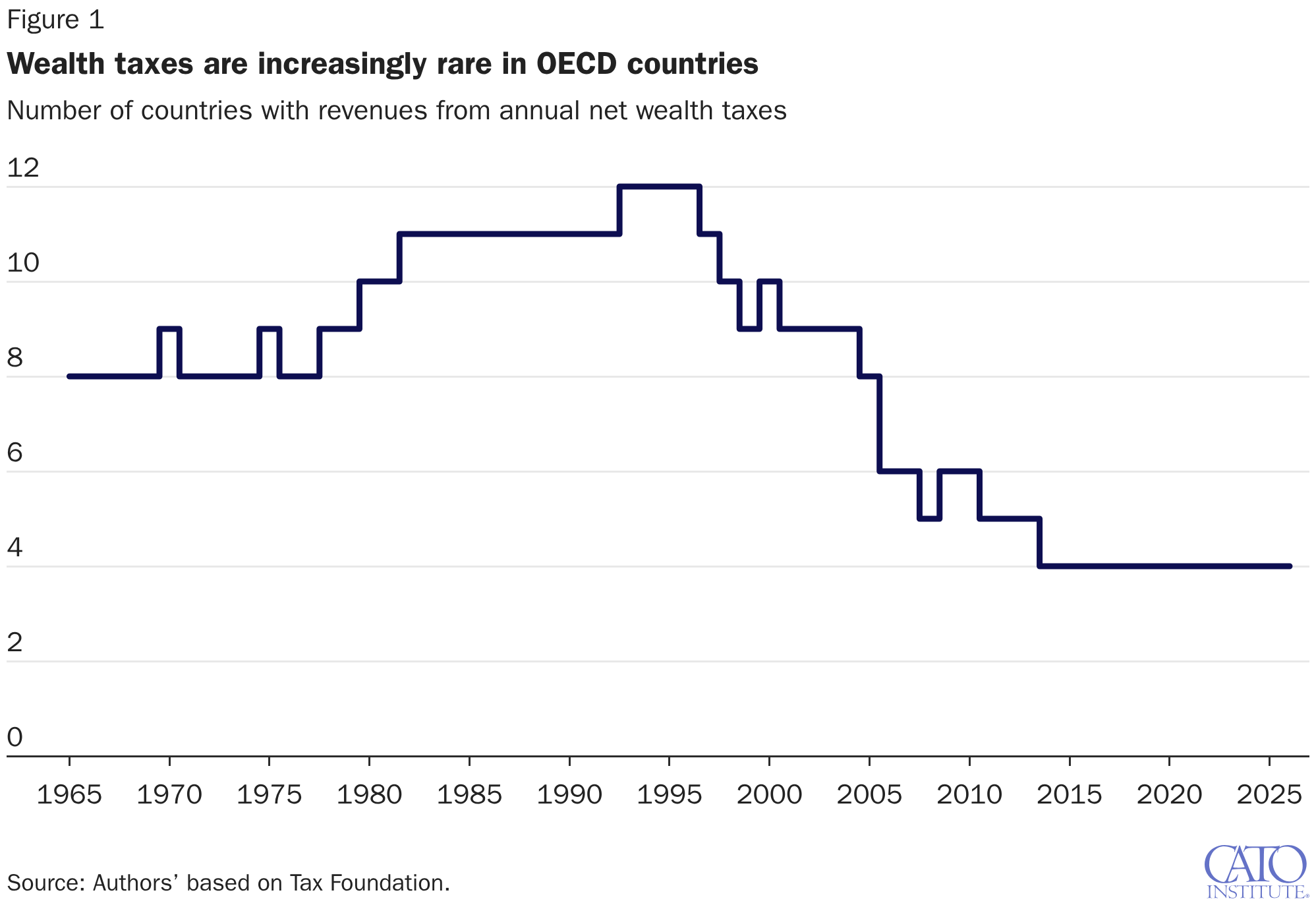
Wealth taxes failed in other countries and will likely fail in the US if tried. Cato’s Adam Michel and Chris Edwards find that the number of OECD countries with annual wealth taxes “fell from 12 in 1990 to just 4 today—Norway, Spain, Switzerland, and Colombia,” as governments learned that wealth taxes “encourage tax avoidance and capital flight, raise little revenue, and tend to become riddled with loopholes.” Those that existed “typically raised only about 0.2 percent of GDP in revenue,” and France’s cost more than it collected: economist Eric Pichet found it raised roughly €3.5 billion a year while the government lost about €7 billion annually in other tax revenues from departing capital. Furthermore, “Wealth taxes will fall, in large part, on American workers in the form of lower wages and fewer job opportunities.” They conclude, “A better way to tax capital and wealth is through consumption-based taxation, which would tax high earners but in a simpler way that does not stifle savings, investment, and growth.”