Debt Digest | Increase in Long-Term Yields Signals Fiscal Failure
Links & Fiscal Facts



Here are this week’s reading links and fiscal facts:
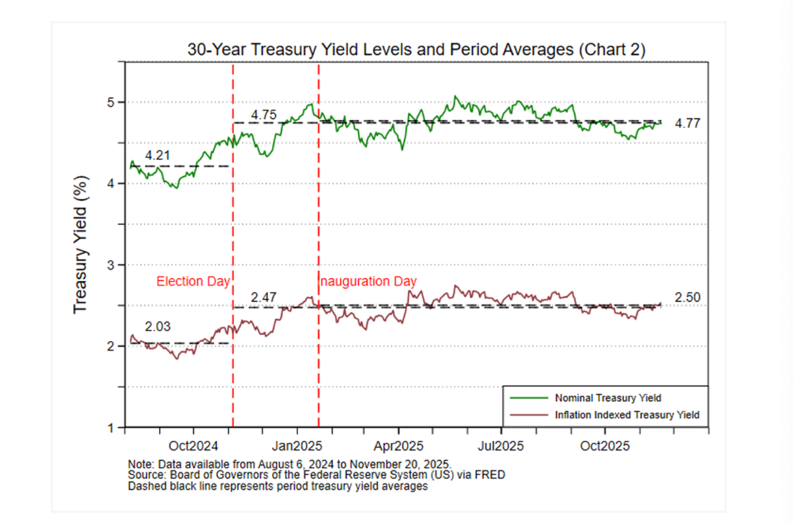
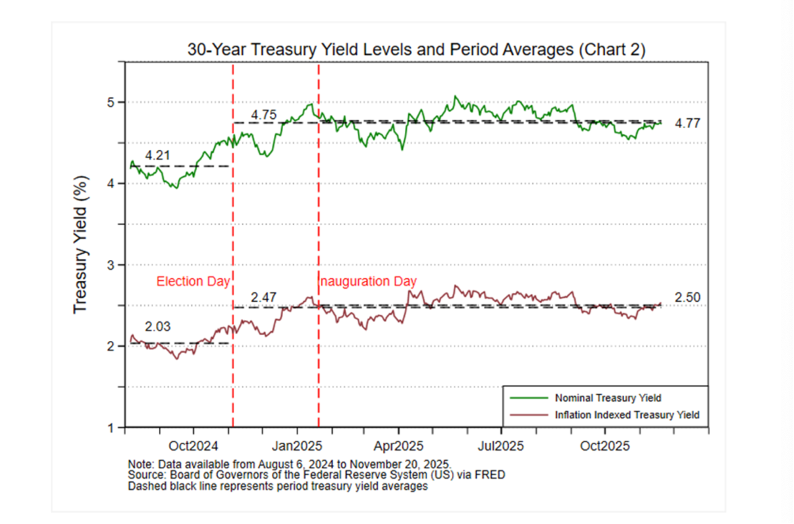
Long-Term Treasury yield rise signals a failure to address budget pressures. AEI’s Mark J. Warshawsky writes: “All yields increased following President Trump’s election and remained higher, on average, following his inauguration. This is particularly clear for the 30-year yields [see figure below].” He explains the factors involved: “The tax cuts were only partially funded by Medicaid and other spending cuts. The cost of health care, financed in large part by the government, continues to rise, and there has been no substantive policy attention to the sector’s fundamental inefficiencies and poor incentives. Tariff policy, although producing revenue, is erratic and of questionable legality. Congress recklessly increased spending on Social Security benefits for some government workers and retirees, and the Administration just passed up on the long overdue opportunity to modernize and simplify the eligibility standards for disability benefits. Fewer immigrant workers mean higher wages in certain sectors like farming and construction, and therefore higher prices. The Administration has not issued a long-range budget plan and it is reported that it will support an extension of higher Obamacare subsidies.”
ACA Enhanced Tax Credits Fuel Fraud, Enrich Insurers, and Inflate Premiums — Congress Should Let Them Expire. Testifying before the Senate Finance Committee, Brian Blase (Paragon Health Institute) and Doug Holtz-Eakin (American Action Forum) warned that enhanced ACA tax credits perpetuate a failed subsidy structure that has driven premiums up 169% since 2013 while consolidating the health insurance market into just a handful of insurers. Blase highlights how CMS data show 40% of fully subsidized enrollees never use their coverage and estimates the enhanced credits have produced 6 million improper enrollments costing taxpayers $27B annually. Both witnesses urged Congress to stop “chasing” unaffordable premiums with ever-larger subsidies and instead expand supply by deregulating short-term limited-duration plans, enabling farm bureau plans, and broadening pooling options for small businesses. Blase proposes ending enhanced credits and redirecting lower-income beneficiaries’ subsidy dollars into patient-controlled HSAs away from insurers. Cato’s Michael Cannon also suggests deregulation as a solution: “Republicans should simultaneously free all employers and individuals to purchase any health plan available in any U.S. territory. Many could buy coverage at a lower premium from the same insurer they have right now. For most Obamacare enrollees, that coverage would be better and cheaper.”
The line between discretionary (annually appropriated) and mandatory (autopilot entitlement) spending is blurring. In a new Congressional Research Service Report Megan S. Lynch explains: “Originally, mandatory spending was provided for things such as health care and income security programs, while discretionary was used to fund agencies and departments. In recent years, however, there has been variation in the types of activities funded by each category. For example, recent reconciliation bills have provided mandatory funding for government departments and agencies typically funded through appropriations such as the Internal Revenue Service, the Department of Defense, U.S. Customs and Border Protection, and OMB. Similarly, some health care programs, such as veterans’ health care, is funded by both mandatory and discretionary spending.” Boccia and Lett highlight fast facts about discretionary spending: “Discretionary spending accounts for less than one third of all federal spending”, and will be roughly a quarter of the total budget by 2033.” This trend is “primarily due to the growth of major mandatory entitlement spending like Social Security and Medicare.”
Should America adopt a balanced budget amendment (BBA)? In an AEI Podcast, Understanding Congress, American Enterprise Institute’s Kevin Kosar and Americans for Prosperity’s Kurt Couchman discuss a BBA. Congress overspends because major programs run on autopilot and lawmakers face powerful incentives to approve immediate benefits while shifting the costs to future taxpayers. With debt near 100% of GDP, recent weak Treasury auctions, and a flight to gold, investor confidence is straining. Kurt Couchman proposes a principles-based amendment that balances the budget over the business cycle—not annually—with a 10-year transition to primary balance and clear emergency exemptions. A constitutional rule provides the political cover lawmakers need to hold the line on deficit spending. Couchman argues politicians “know what to do—they just don’t know how to survive it.” A BBA gives them a higher authority to point to when making tough choices. We are hosting a book forum at Cato (and online) on December 10 at NOON ET on Couchman’s new book Fiscal Democracy in America: How a Balanced Budget Amendment Can Restore Sound Governance. Join us for a discussion with the author and Marc Goldwein (CRFB), moderated by Romina Boccia.
Further transparency from the CBO and JCT will help address fiscal crisis. Joshua Rauh and Benjamin Jaros write in the Wall Street Journal: “Washington is hurtling toward a spending crisis, but the fiscal watchdogs meant to check its excesses are already trapped in a crisis of credibility. […] Years of opacity from the CBO and JCT have produced costly errors that no one outside the agencies could detect before it was too late.” They recommend that “[l]awmakers should require both agencies to publish the code, data and documentation behind major estimates, just as academics must. Replication wouldn’t eliminate forecasting uncertainty, but it would expose assumptions, stabilize expectations, and allow external experts to flag errors before Congress votes.” Alongside more transparency in methodology, Boccia and Lett recommend requiring CBO to include projected interest costs and removing emergency spending from the budget baseline.” They emphasize the sentiment: “Promoting a more realistic, accurate understanding of the budget will be a necessary step in building consensus around a sustainable fiscal future.”