Debt Digest | Deficit Spending is Driving Up Homeownership Costs
Links & Fiscal Facts



Here are this week’s reading links & fiscal facts:
Deficit Spending Is Driving Up Homeownership Costs. Persistent federal deficits from a “spendthrift government… are partly to blame” for America’s affordability crisis, writes Martha Gimbel for The Atlantic. “The United States owes $31.6 trillion to public creditors, more than $290,000 for each household.” As Gimbel explains, “when the government needs to borrow funds to cover existing and new promises, these demands compete with those of all borrowers, which drives up interest rates for everyone.” This has “saddled many American families with higher costs, largely from rising interest rates.” For example, “for someone taking out a 30-year mortgage at last year’s median home price, this rise in long-term interest rates has increased their borrowing costs by around $2,500 a year, or roughly $76,000 over the life of the loan.” With affordability becoming a “watchword for politicians who understand that rising prices are hurting American families,” Gimbel argues that “we should be talking about how deficit spending is making it harder to pay our own bills.”
Half of the East Wing Ballroom’s $600 Million Price Tag Falls on Taxpayers. The White House's East Wing ballroom project is shaping up to cost far more than promised and taxpayers are footing much of the bill for it. As Sarah Blaskey and Jonathan O'Connell report for The Washington Post, internal contractor estimates put the project’s costs at “$600 million — with more than half coming from taxpayers.” This contradicts the administration’s claims that “the price tag would not exceed $400 million” and that the project would be covered entirely by private donors, with “no taxpayer putting up 10 cents.” As they report, internal cost estimates are “significantly higher than administration officials acknowledged in public comments or court filings,” and show that the “work was projected to rely heavily on taxpayer dollars from the moment it was announced.” As Senator Susan Collins (R-Maine) said, “President Trump indicated that the ballroom was going to be built with private donations… that’s the commitment that should be kept.”
Join us this Tuesday at NOON at the 130 Cannon House Office Building for a Capitol Hill briefing hosted by the Cato Institute titled: “Fixing Medicaid’s Financing Structure to Reduce Waste, Fraud, and Overspending,” featuring Michael F. Cannon (Cato Institute), Chris Pope (Manhattan Institute), and Brian Blase (Paragon Health Institute).
Restricting Medicaid Financing Schemes Could Save $350 Billion Over Ten Years. Congress can save $350 billion over the next decade by restricting states’ use of financing gimmicks, according to a new report from the Committee for a Responsible Federal Budget (CRFB). As the Debt Dispatch has previously covered, “for years, states have used creative financing schemes to game the Medicaid system, effectively laundering billions in federal dollars with little transparency or accountability.” States use provider taxes, for example, to “tax” health care providers, rebate the money back to those same providers through Medicaid payments, then claim federal matching funds to push more of the program’s costs onto federal taxpayers. Although the One Big Beautiful Bill Act restricted states’ use of provider taxes, CRFB estimated that phasing them out entirely could save $250 billion over ten years. Restricting other Medicaid financing gimmicks could save another $100 billion. However, as Cato scholars Michael F. Cannon, Krit Chanwong, and Dominik Lett point out, Medicaid’s matching grant system will “continue to offer states opportunities to abuse the program. The only way to eliminate those opportunities” is to block grant Medicaid.
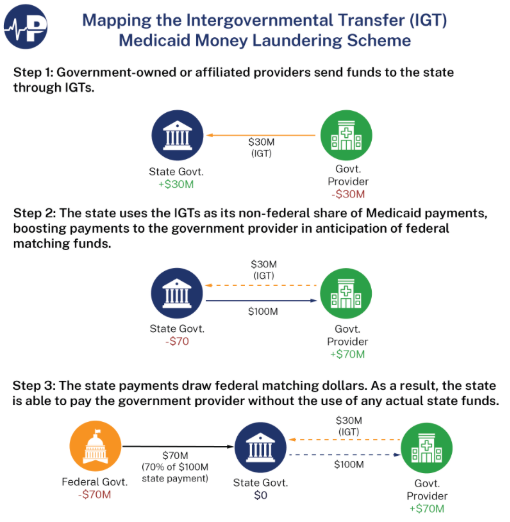
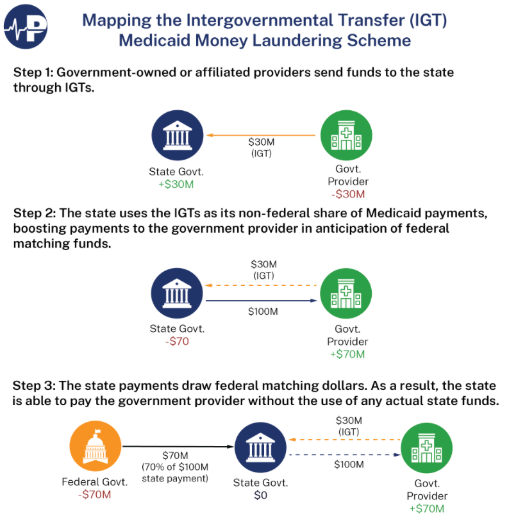
States Exploit Intergovernmental Transfers to Shift Medicaid Costs to Federal Taxpayers. Intergovernmental transfers (IGTs) are a “heavily abused” Medicaid financing gimmick that has received less scrutiny than other schemes, warn Paragon scholars Brian Blase, Chris Medrano, and Mark Howell. IGTs allow government-owned providers to transfer funds to the state, which then uses those funds to make Medicaid payments back to those same providers. States count this spending toward their Medicaid share to secure federal matching dollars without making any genuine expenditures. These schemes distort Medicaid’s financing structure by shifting costs from states to federal taxpayers, who frequently bear the cost of Medicaid payments to government-owned providers that far exceed what private providers receive for the same services. Congress should bar states from counting IGTs toward their reported Medicaid spending, or at least “prohibit states from paying government providers more than private providers for the same services… and rigorously scrutinize state IGT proposals.”
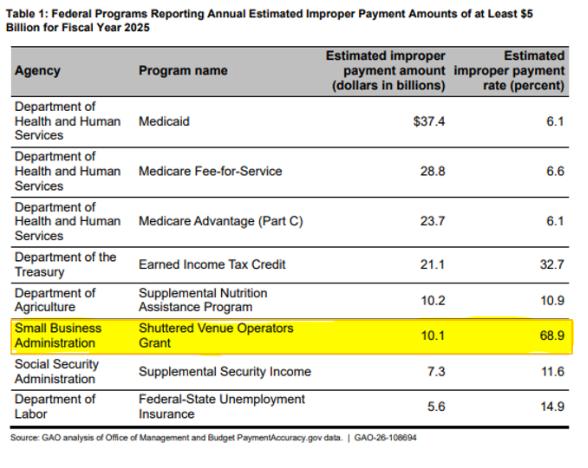
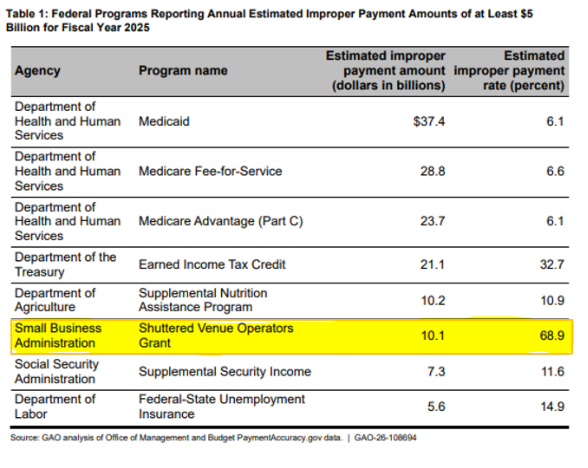
The COVID Program with a 70 Percent Error Rate. As Manhattan Institute scholar Judge Glock writes in the Wall Street Journal, the COVID-era Shuttered Venue Operators Grant (SVOG), a federal handout for theaters and music halls, “reported $10 billion in improper payments, nearly 70 percent of all spending in the program,” last year. One reason: the Small Business Administration failed to properly utilize the Treasury's Do Not Pay system, a data-matching tool previously covered by the Debt Dispatch that flags potentially improper payments before they go out the door. When the agency cross-checked SVOG applications using the tool, nearly two-thirds were flagged. But under public pressure to “throw money out the door fast,” officials frequently ignored Do Not Pay’s warnings, arguing that the matches were slowing down award processing. As Glock points out, “when politicians and the press push the government to hand out more cash without strings, ordinary Americans pay for it.”