Here are this week’s reading links and fiscal facts:
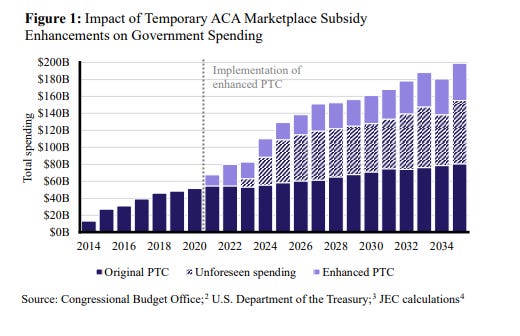
Let the enhanced ACA premium tax credits expire. Eleanor Mueller and Burgess Everett report in Semafor: “The House could vote as soon as this week on a three-year extension of enhanced Affordable Care Act subsidies after enough Republicans helped Democrats force a vote.” The Joint Economic Committee has published an issue brief on why the subsidies should expire. Their four main reasons are “Enhanced premium tax credits (PTCs) have outlived their temporary purpose and are fiscally unsustainable, reduced price competition benefits insurers and leads to economic deadweight loss, zero-claim enrollees subsidize insurers, and permanent extension entrenches market distortions and shirks fiscal responsibility.” Cato’s Adam Michel echoes these reasons: “Sold as a temporary boost during the COVID-19 pandemic, the subsidies are costly, fraud-prone, and primarily pad insurance companies’ profits.” Boccia and Turman have also written that “these subsidies are a fiscal boondoggle that doles out taxpayer-funded health insurance to high-income earners. Congress should let these partisan and poorly targeted subsidies expire.”
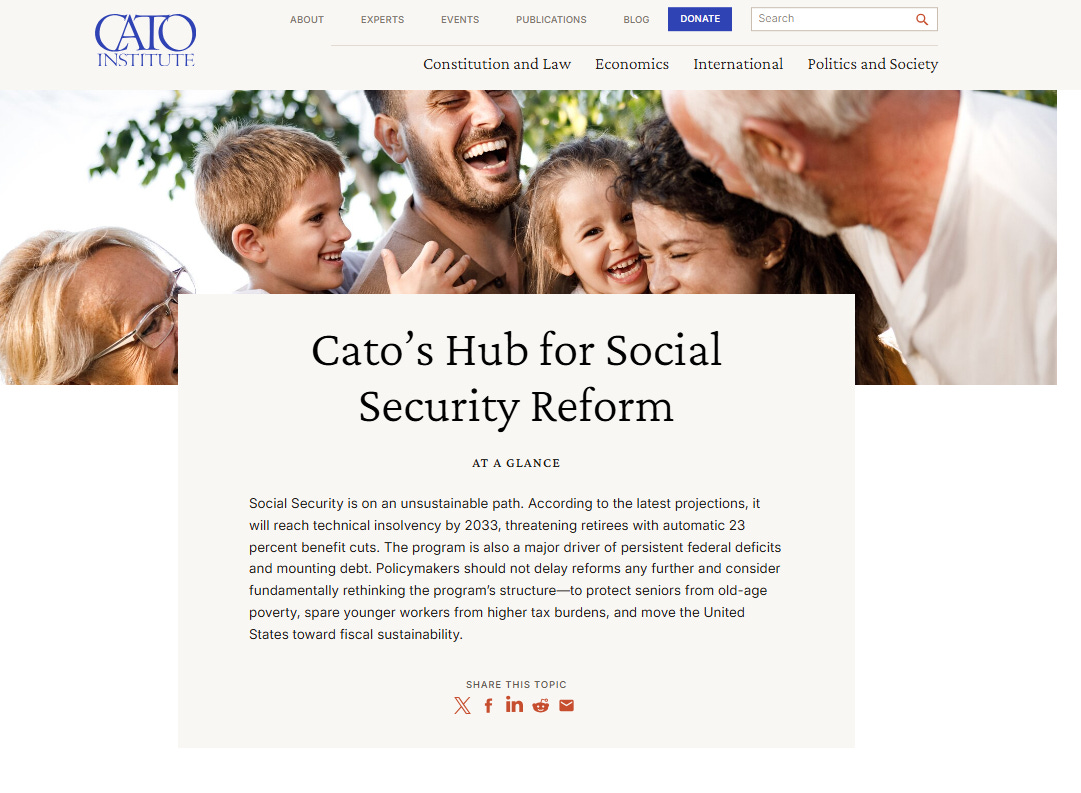
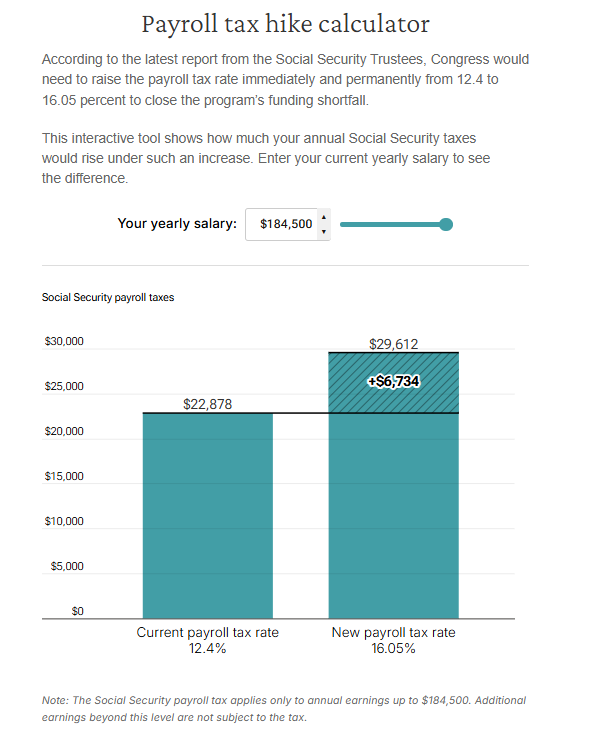
Check out Cato’s Hub for Social Security Reform. The new website features an interactive tool (picture below) that demonstrates your annual tax increase from raising the payroll tax immediately and permanently from 12.40 to 16.05 percent to close Social Security’s funding shortfall. Plug in your annual salary to see the tax increase for yourself. For the median worker, “this tax increase would reduce lifetime earnings by more than $110,000 in present value terms over a 45-year career.” At the beginning of this year, the Social Security maximum taxable earnings increased from $176,100 to $184,500. Find everything related to Social Security on the website, including The Social Security Trust Fund Myth, Congress Can’t Outgrow or Inflate Away the Social Security Financing Problem, and Rethinking Social Security from a Global Perspective.
California wealth tax proposal reveals the problems with wealth taxes. Jack Salmon of the Mercatus Center breaks down the issues with the “ballot initiative that would impose a one-time 5% tax on the net worth of state residents with at least $1 billion in wealth”. First, “a one-time wealth tax still requires the state to determine the fair market value of assets that are not regularly traded, including private equity stakes, closely held businesses, intellectual property, artwork and complex trust arrangements.” Second, “A small fraction of taxpayers accounts for a disproportionate share of personal income tax receipts, with the top 1% typically contributing 40-50% of all state income tax receipts.” These issues reveal broader issues with wealth taxes, as Cato’s Adam Michel explains, “Such confiscatory tax rates would have myriad negative economic consequences, including disincentivizing entrepreneurship, reducing employment, slowing wage growth, and shrinking domestic output. Wealth taxes also encourage tax planning by highly mobile wealthy individuals who can leave countries with confiscatory tax systems.” Salmon concludes, “A wealth tax does not begin to fail when revenue falls short of projections. It becomes problematic when it introduces a new layer of uncertainty around residency, valuation and future tax treatment for the taxpayers who disproportionately finance the system.”
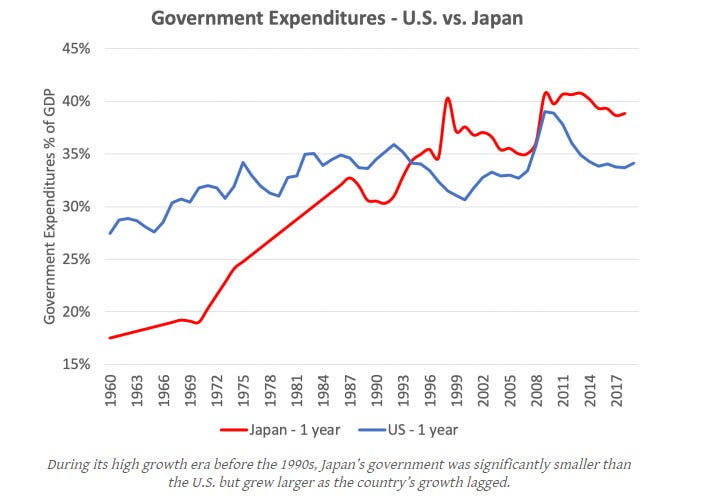
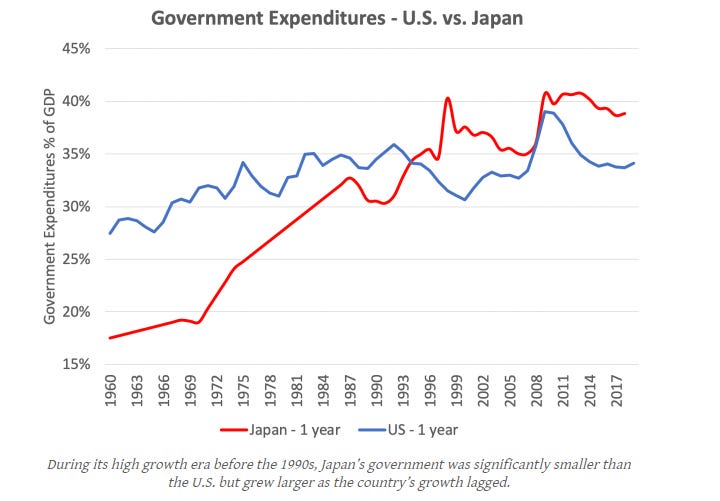
Japanese government growth should be a warning for the US’s trajectory. Douglas Carr writes in National Review: “from 1961 to 1992 Japan’s growth averaged 5.5 percent compared with 3.5 percent for the U.S. […] From 1993 to 2019, the U.S. averaged 2.6 percent growth, well behind the earlier era, but far ahead of Japan’s meager 0.9 percent.” The reason for this flip, Carr argues: “Big government happened—to Japan and, to a lesser extent, to the U.S. Japanese government spending was just 17.5 percent of the country’s GDP in 1960 but has grown, as illustrated below, to 38.8 percent of GDP today.” Carr warns that “the United States is at risk of entering a Japanese death spiral”. He explains the solution: “Boosting growth means restraining government. Restraining government means reengineering entitlements, which are the root of U.S. government growth.”
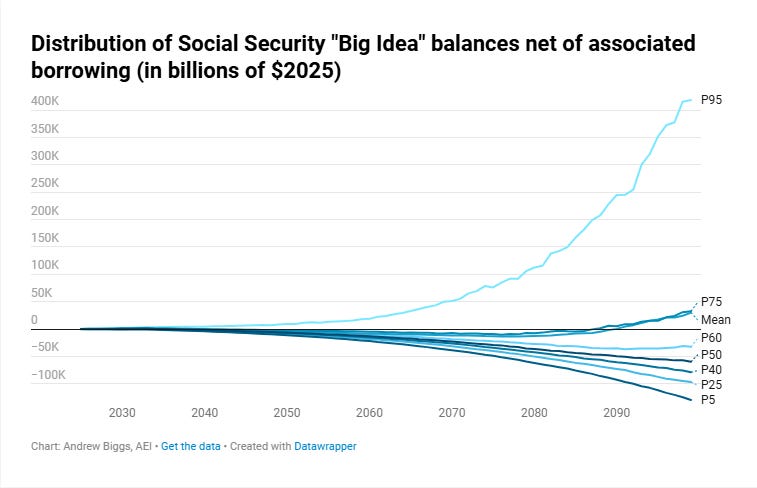
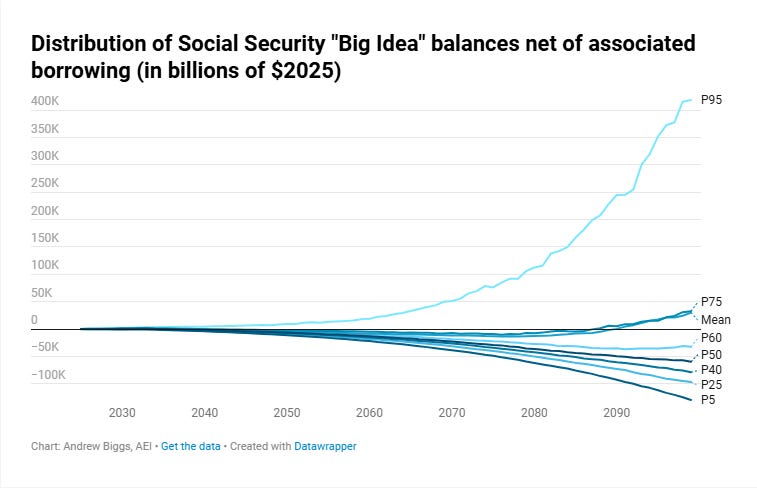
Stress test of Cassidy-Kane Social Security Plan reveals huge risk with taxpayer money. Andrew Biggs of the American Enterprise Institute conducted a simulation of possible scenarios of the Cassidy-Kane [“Big Idea”] plan to borrow and invest funds to eventually pay off the Social Security balance after 75 years. The chart below demonstrates that most of the time, this plan doesn’t work. In roughly three out of four scenarios, the promised surplus from investing never shows up. And in about seven out of ten cases, the fund still doesn’t have enough money to pay off the debt. As Biggs warns: “there is a 1-in-10 chance that the Big Idea fund would finish 75 years owing over $129 trillion in debt. Social Security’s Trustees project that real GDP in 2100 will be about $96 trillion.” The plan is akin to a sovereign wealth fund, which as Boccia says, “The idea that Washington should set up an investment fund when it can’t even manage its own budget is laughable at best and dangerous at worst.” Biggs emphasizes why the plan is a distraction from actual reform: “The design of the Big Idea fund means the government is giving up decades of opportunities to slowly-but-surely adjust Social Security for solvency and effectiveness. That could prove disastrous.”