


Here are this week’s reading links and fiscal facts:
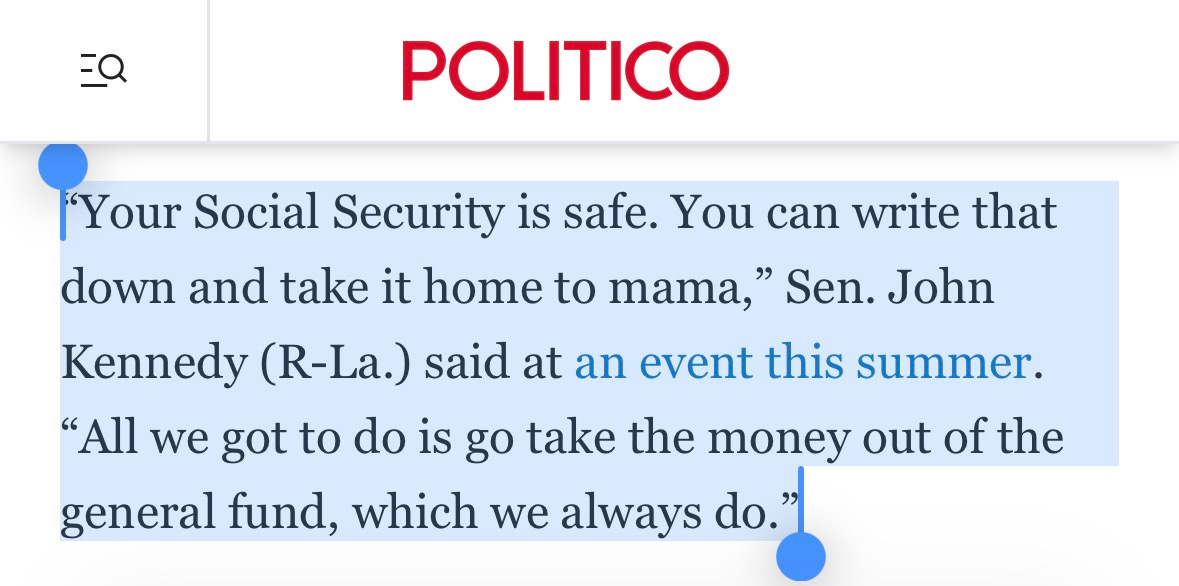
Borrowing to fund Social Security is dangerous. Jennifer Scholtes and Katherine Tully-McManus report in Politico that “some lawmakers have been telling voters the whole notion of a cliff is a hoax.” They point to a claim by Sen. John Kennedy (R-La.): “Your Social Security is safe. You can write that down and take it home to mama. […] All we got to do is go take the money out of the general fund, which we always do.” Boccia and Nachkebia warn of the tremendous danger of this idea, as borrowing to maintain scheduled benefits “would add roughly $46 trillion to federal debt between 2026 and 2056.” They emphasize, “It would shift the program’s shortfall onto the federal budget, increase interest costs, and expose workers and taxpayers to the economic risks of higher debt. Borrowing may postpone benefit reductions, but it won’t make Social Security sustainable.”
The Social Security 2100 Act hurts workers. Aurielle Weiss reports in the New York Post that the Social Security 2100 Act, reintroduced by Rep. John Larson (D-CT) in June, “would increase benefits while shoring up Social Security’s finances by making higher-income Americans pay more into the system.” Under the bill, “all current and new beneficiaries would see a 2% benefit increase,” “the new minimum benefit would change to 125% of the Federal poverty line,” and the COLA calculation would switch “to the CPI for the Elderly (CPI-E).” Boccia argues that an earlier version of the bill “would expand Social Security in size and scope, to the detriment of workers.” It “adopts more than a dozen benefit increase provisions, but only for five years. […] It’s a common gimmick in spending and tax bills to obscure the long-term budgetary impact from provisions that will most likely be made permanent.” She concludes, “once you put a benefit increase in place, good luck trying to get rid of it later.”
Compulsory saving does not make households wealthier or retirees better off. Michael Littlewood writes that “Australia’s compulsory system has transformed how household wealth is packaged there: superannuation is 49% of Australian household financial assets against 11% in New Zealand. However, it has not made households wealthier, relative to their incomes: net worth is nine to ten times income in both countries.” Debt did move: “Australian household debt has climbed to 177% of income while New Zealand’s has been flat at about 125% for two decades.” Nor did retirees fare better: “Compulsory ‘private’ provision seems not to have helped reduce the incidence of poverty amongst the old.” He concludes, “perhaps a government cannot force its citizens to save more than they want to save.” Boccia warns of the same tradeoff in WaPo: auto-enrolled workers “are more likely to offset default retirement contributions by taking on debt.” In WSJ, she points to a better alternative: “A better model is New Zealand, which provides all retirees with a flat retirement benefit coupled with automatic enrollment in the KiwiSaver plan, but, unlike Australia’s compulsory superannuation system, workers are allowed to opt out.”
Europe and China are attempting to compete with the dollar. Barry Eichengreen writes in the New York Times that “the dollar’s champions are still trying to make the case that there is no alternative to the dollar. But Europe and China are working as fast as they can to rectify this deficiency.” Europe is advancing a Capital Markets Union for “euro-denominated financial securities,” while China expands its renminbi-based payments system “to compete with large U.S. banks and the dollar.” Eichengreen’s verdict: “They are acting as if there is no time to waste. On the evidence, they are right.” Boccia warns what this signal might mean: “As U.S. publicly held debt continues to grow, the volume of outstanding U.S. treasuries makes the federal government’s ability to borrow vulnerable to sudden shifts in investor sentiment and changing market conditions. Should a financial panic ensue, the government has little chance of stopping the flood wave of declining bond market sales, rising interest rates, and pressure to monetize the debt via the Federal Reserve. In the worst-case scenario, the United States might even lose its standing as the world’s preeminent reserve currency, with implications for America’s economy and national security.”
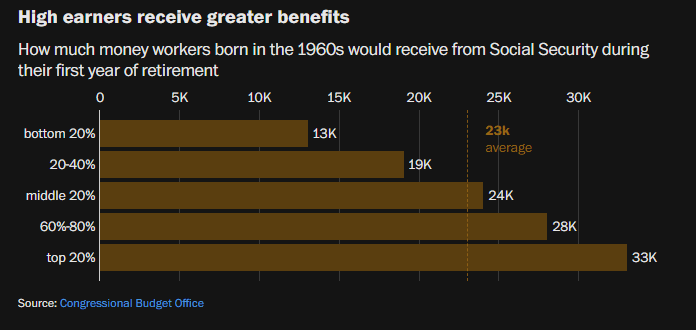
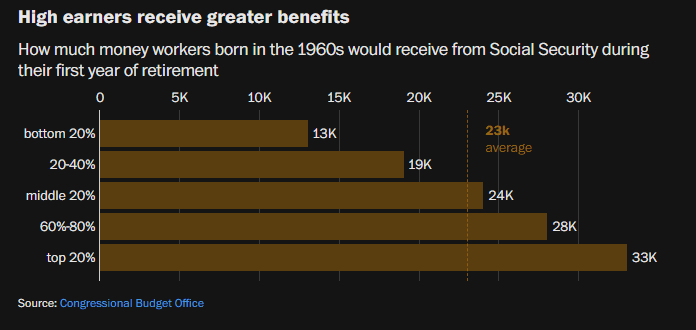
Stop subsidizing wealthy retirees. Andrew Biggs writes in the Washington Post that “the wealthiest fifth of households receives 38 percent of taxpayer dollars spent on Social Security and retirement tax preferences, more than the bottom 60 percent.” Because “top earners collect more and live longer, they take 33 percent of total Social Security benefits, leaving a mere 8 percent for the lowest-earning quintile.” His solution: limit “annual benefits to $24,000 per person — the average benefit paid to the middle-income quintile — fixing roughly 60 percent of Social Security’s long-term deficit.” Federal retirement programs, he concludes, “should prevent old-age poverty and encourage saving — not bankroll retirement lifestyles that affluent Americans can pay for themselves.” Boccia agrees that the program should be refocused on its original purpose, and adds: “It may not be ‘fair,’ but it’s the only plausible path forward. The goal of reform should not be to preserve Social Security in its current form, but to prevent the worst outcomes.”
Romina,
You are a national treasure. Our country needs the truth you are providing.
Thank you,
Mark Guyer