
Debt Digest | AI-Driven Productivity Gains Would Worsen the Fiscal Outlook, Without Health Care Reform
Links & Fiscal Facts


Here are this week’s reading links and fiscal facts:
Australia’s superannuation system isn’t the Social Security fix Trump imagines. Samuel Gregg of the American Institute for Economic Research writes in WSJ that President Trump has praised Australia’s private pension model. Gregg comments: “One positive lesson of ‘super’ is that pension systems in which the private sector plays an ever-growing role can help address the threat of insolvency confronting U.S. Social Security.” But “other features of the Australian system […] should give Social Security reformers pause” — heavy regulation, high fees, weak accountability, and union-dominated funds. His verdict: “That system doesn’t work as well as Mr. Trump supposes, and ignoring its weaknesses would be a serious error.” Boccia warns the proposal is “a classic case of ‘bootleggers and Baptists’ joining forces to push bad policy.” Financial firms are “the bootleggers,” drawn by “millions of new, automatically enrolled customers, aided by government funding.” The Baptists in this case: “Progressives see an opportunity for greater government involvement in retirement saving,” […] Conservatives, meanwhile, are likely to see these accounts as a way to privatize or replace Social Security.”
PROMISE Act makes the correct diagnosis on Social Security reform. Jeffrey Brown comments on the new PROMISE Act: “I think the diagnosis behind PROMISE is correct. The obstacle to Social Security reform has never been a shortage of good analysis—we have decades of it. The obstacle is the absence of a forcing mechanism that converts analysis into a vote on a specific policy recommendation. A fast-track process aimed at breaking that logjam is a serious idea, and the senators who introduced it deserve credit for treating the problem as a problem of process, not just policy.” While he looks to the Greenspan Commission as a potential model for success, Boccia disagrees. She argues, “Despite a favorable retelling of history, modeling such a commission after the 1981 Greenspan Commission is bound to fail.” The panel deadlocked, rescued only by a last-minute deal under a hard deadline that won’t reoccur until 2032. Plus, the size and scope of the current shortfall, compared to then, is vastly larger too, making similar tweaks around the edges no longer sufficient. A BRAC-style commission, “relying on independent experts and using a fast-track procedure that allows for silent approval in Congress […] is much more promising because it provides more cover for Congress and takes politics out of the commission process.”
Bigger Medicare subsidies for wealthy seniors? A new bill by Rep. Tom Kean, Jr. (NJ-07) and Rep. Young Kim (CA-40) is Robin Hood in reverse, stealing from the poor to give to the rich. The Kean-Kim bill would increase government subsidies to high-income seniors. Individuals earning $109,000–$171,000/year would get an average of $2,892. Couples earning $218,000–$342,000/year would get an average of $5,784. As Cato’s Michael Cannon told us “These are folks who fall into the 60–95th income percentiles, which means that paying for these subsidies would inevitably require redistributing wealth from lower-income households to higher-income households. The subsidies come from reducing high-income Medicare enrollees’ premiums down to the same levels as lower-income enrollees. The result is that high-income enrollees would pay for less of their health care and thus receive a larger net subsidy from Medicare.” High-income seniors already receive too much from Medicare: Joe Albanese of the Paragon Health Institute finds that “wealthier Medicare enrollees currently have 15 to 65 percent of their estimated Part B costs [physician services] subsidized by taxpayers.” With Medicare driving the federal government toward a fiscal cliff, Cannon argues: “Congress needs to curb Medicare spending. The most sensible place to start is by reducing subsidies to wealthy seniors.”
Germany is overhauling Social Security while the US stalls. Mark J. Warshawsky of the American Enterprise Institute writes that the German Pension Security Commission “issued its proposal for reform of Germany’s Social Security program, and the Merz government said it would accept the proposal in whole and push it quickly through the Bundestag.” As he describes it, “Notable features of the proposal, put together by a committee of technical experts and politicians, are the introduction of personal investment accounts, an increase in regular and early retirement ages, disability reforms, changes to rules governing employer-provided retirement plans, and an explicit rejection of raising the cap on taxable earnings.” Warshawsky’s verdict: “One must express admiration for Germany on their clean, comprehensive, balanced and largely sensible Social Security reform proposal, compared to the continued inaction in the US.” These are similar lessons that Boccia and Nachkebia draw in Reimagining Social Security, which studies Germany alongside other nations and urges the US toward a higher retirement age, automatic balancing, and expanded private saving, without raising payroll taxes.
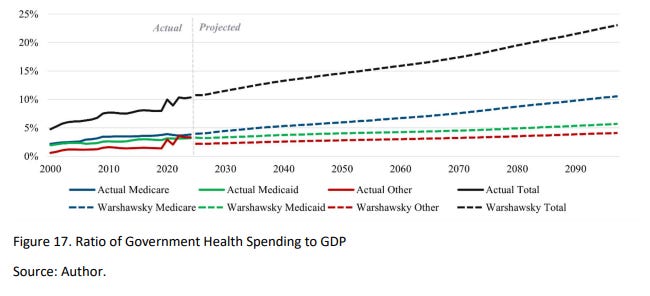
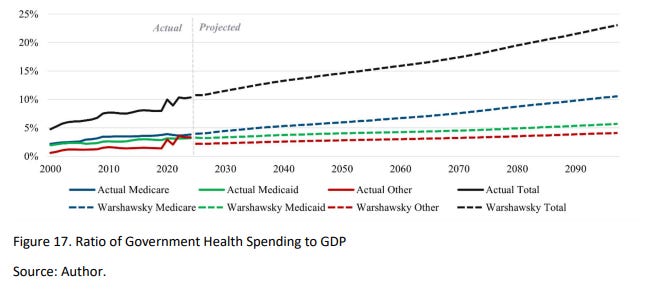
Higher productivity worsens the fiscal outlook; health reform can fix it. Mark J. Warshawsky of the American Enterprise Institute models federal finances and health spending in a new working paper. In it, “rising costs of health care come from labor shortage effects in an aging economy because health care is produced in a low productivity, labor-dependent sector — a dynamic Baumol cost-disease effect,” and “Health care expenditure increases further deteriorate the federal budget and lowers consumer welfare.” Modeling AI-driven productivity gains against comprehensive reform, Warshawsky finds that “higher productivity, per se, actually worsens the fiscal situation, but health reform would lead to a significant improvement.” Boccia and Thakur echo the point on Medicare, the debt’s biggest driver: “Every pathway through which growth occurs—innovation, longer lives, cost disease—feeds directly into higher Medicare spending.”
Scary trajectory for Medicare… if SS reform is still politically toxic even with highly visible cuts looming, surely Medicare will be even harder? Is there any political will behind the scenes?